
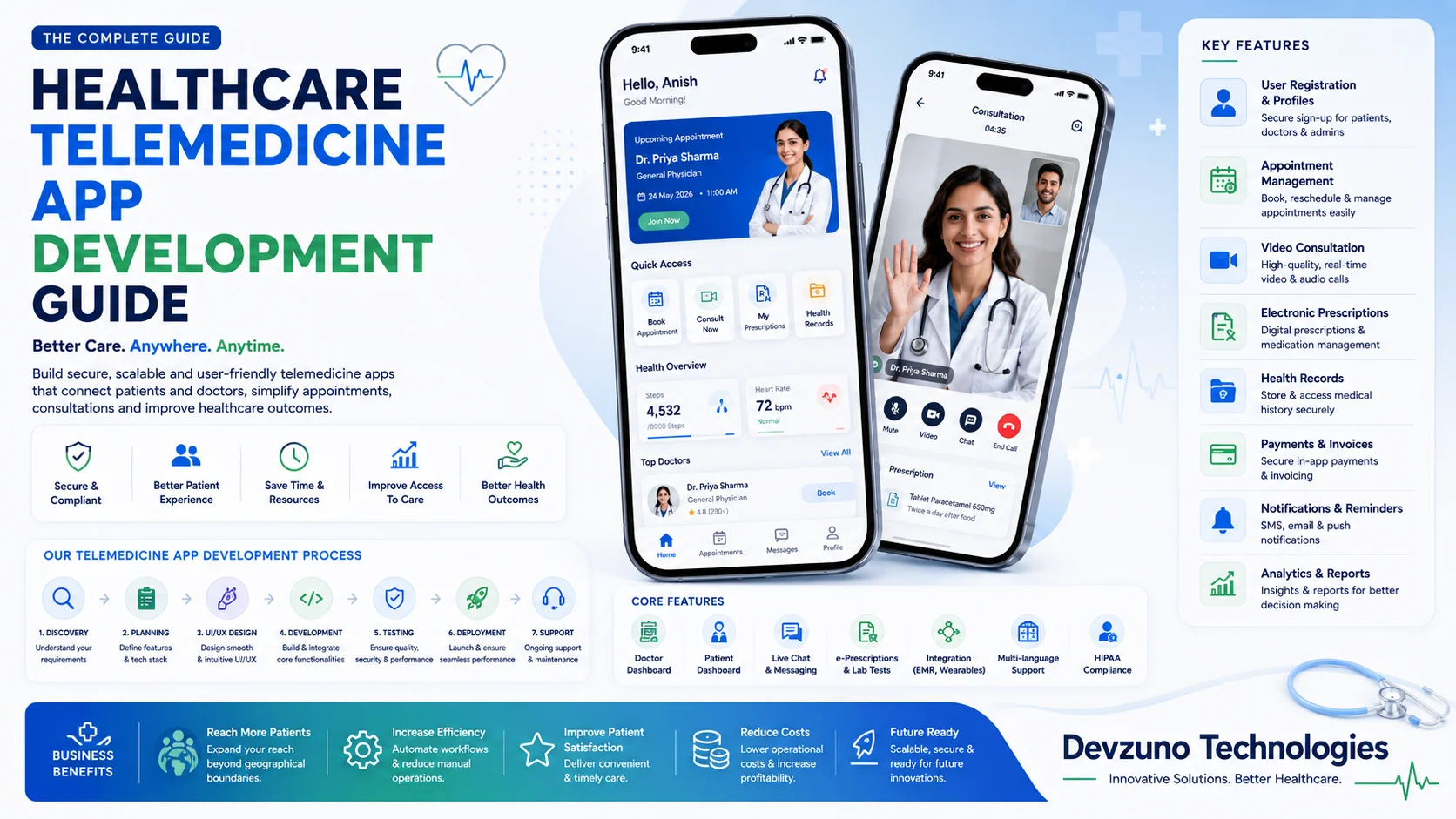
In 2026, the digital health and telemedicine sector in India is experiencing exponential growth. Driven by government initiatives like the Ayushman Bharat Digital Mission (ABDM) and growing patient preference for remote medical consultations, healthcare providers—including multi-specialty hospitals, polyclinics, diagnostic chains, and HealthTech startups—are building custom mobile applications to deliver remote care.
Relying solely on third-party doctor discovery portals (like Practo or Lybrate) often exposes clinic practices to high consultation commission fees, shared patient data, and brand dilution. Building a custom telemedicine mobile application paired with an integrated Electronic Health Record (EHR) system allows medical providers to own their patient relationships, automate appointment slot scheduling, and provide secure video consultations.
In this comprehensive guide, we compare custom healthcare apps against third-party aggregators, outline essential feature modules, examine WebRTC video architecture, detail ABDM/HIPAA security compliance standards, explore wearable device integrations, and provide an itemized cost breakdown in Indian Rupees (₹) and USD ($).
1. Third-Party Health Aggregators vs. Owned Custom Healthcare Platform
While third-party doctor discovery platforms provide initial patient reach, established clinics and growing HealthTech enterprises require a dedicated digital channel.
Below is a comparative analysis between third-party health aggregators and a custom healthcare mobile app:
| Evaluation Metric | Third-Party Aggregator Platforms (Practo / 1mg) | Custom Healthcare & Telemedicine App (Devzuno Architecture) |
|---|---|---|
| Patient Data Ownership | Platform owns patient records & contact data | 100% Full Ownership of Patient EHR & Data |
| Consultation Fees & Margins | High per-consultation commissions (15% – 25%) | 0% Commission Fees (Direct doctor-patient payment) |
| Brand Identity | Competitor doctors displayed alongside your clinic | 100% Brand Focus (Your hospital & doctors only) |
| ABDM / ABHA Card Sync | Generic integration | Native ABDM M1, M2, M3 Compliant Integration |
| E-Prescription & Pharmacy Sync | Restricted to aggregator partner pharmacies | Direct In-House Pharmacy & Lab Test Routing |
| Source Code & IP Rights | Locked into vendor subscription ecosystem | 100% Source Code & Intellectual Property Ownership |
Why Hospitals & Clinics Transition to Custom Telemedicine Apps
- Direct Patient Retention: Patients book follow-up consultations directly on your hospital app without being lured away by competitor doctor ads.
- Encrypted Data Security: End-to-end encryption ensures patient medical history, lab reports, and video calls remain strictly confidential and legally compliant.
- Streamlined Hospital Workflow: Automated appointment reminders, digital e-prescriptions, and integrated billing reduce front-desk administrative overhead by up to 50%.
2. Must-Have Modules for a Telemedicine & Clinic App
A modern healthcare ecosystem consists of three interconnected applications: a Patient Mobile App, a Doctor Mobile/Web Portal, and a Hospital Admin Dashboard.
A. Patient Mobile App Features (iOS & Android)
- HD Video & Audio Teleconsultation (WebRTC Engine): Low-latency, encrypted video calls allowing patients to consult specialists remotely from any smartphone.
- Doctor Discovery & Appointment Slot Booking: Search doctors by specialty, experience, language, fee, and real-time calendar slot availability.
- ABDM ABHA Health ID Generation & Sync: Allow patients to create or link their 14-digit ABHA (Ayushman Bharat Health Account) ID to receive government digital health records automatically.
- Encrypted Medical Record Vault (EHR): Patients can upload and view blood test reports, X-rays, MRI scans, and past prescriptions securely.
- Home Lab Test & Pharmacy Ordering: 1-tap booking for home sample collection and prescription medicine delivery.
B. Doctor Portal & E-Prescription Features
- Digital E-Prescription Generator: Doctors can generate standardized digital prescriptions in under 60 seconds with pre-populated dosage templates and ICD-10 medical coding.
- Interactive Consultation Queue: View real-time daily appointment lists, patient medical history, and emergency call requests.
- Integrated Digital Signature: Add verified e-signatures to digital prescriptions to ensure pharmacy validity.
3. Security, Regulatory Compliance & ABDM Integration (India & Global)
Healthcare software handles highly sensitive Personal Health Information (PHI). Failing to meet regulatory standards can lead to severe legal penalties.
A. ABDM (Ayushman Bharat Digital Mission) Compliance in India
Our healthcare architecture integrates official ABDM milestones:
- ABDM M1: Creation of ABHA Health IDs and patient demographic verification.
- ABDM M2: Health Information Provider (HIP) integration—enabling clinics to link e-prescriptions and diagnostic reports to ABHA cards.
- ABDM M3: Health Information User (HIU) integration—allowing doctors to request access to past medical history with patient consent.
B. DPDP Act 2023 & HIPAA Compliance Standards
- Data Localization: Storing all patient data on secure cloud data centers located physically within India in compliance with the DPDP Act 2023.
- Consent Management Engine: Explicit digital consent prompts before sharing patient medical records with attending specialists.
- Video Stream Security: Encrypted WebRTC protocols (DTLS-SRTP) preventing eavesdropping on teleconsultation calls.
- Database Encryption: AES-256 encryption at rest for all database fields storing patient medical records.
4. Technical System Architecture: WebRTC Video & Encrypted Backend
Building a telemedicine platform capable of handling real-time HD video streams and instant health record sync requires robust microservices:
[Patient Mobile App (Flutter)]  <--->  [Doctor Mobile/Web Portal (Flutter)]
               │                                   │
               └─────────────────┬─────────────────┘
                                 ▼ (WebRTC & HTTPS)
                   [API Gateway & Rate Limiter]
                                 │
         ┌───────────────────────┼───────────────────────┐
         ▼                       ▼                       ▼
 [WebRTC Video Server]  [E-Prescription Engine]  [ABDM Health Gateway]
         │                       │                       │
         └───────────────────────┼───────────────────────┘
                                 ▼
           [PostgreSQL DB (AES-256)] + [Redis RAM Session Cache]
Architectural Component Breakdown
- Mobile Frontend Layer: Flutter (Dart) provides a single unified codebase for iOS and Android, ensuring 60-120 FPS fluid UI performance on budget Android devices and iPhones alike.
- Real-Time Video Engine: WebRTC / Agora RTC Engine delivers sub-200ms low-latency video streaming optimized for fluctuating 3G/4G/5G mobile networks.
- Encrypted Storage Layer: PostgreSQL with AES-256 field-level encryption paired with AWS S3 / Supabase encrypted buckets for medical file storage.
5. Remote Patient Monitoring (RPM) & Wearable Bluetooth Device Sync
For chronic disease management (diabetes, hypertension, cardiac care), modern healthcare apps integrate Remote Patient Monitoring (RPM):
- HealthKit & Google Health Connect Sync: Automatically syncing daily step counts, heart rate trends, and sleep metrics from Apple Watches, Fitbit, or Galaxy watches.
- Bluetooth Medical Device Sync: Direct BLE (Bluetooth Low Energy) pairing with blood pressure monitors, digital glucose meters, and pulse oximeters.
- Vitals Out-of-Range Alerts: Triggering automatic push notification alerts to attending doctors when a patient’s vitals cross predefined safety thresholds.
6. Cost Breakdown for Healthcare & Telemedicine Apps in India (2026)
Healthcare app development costs depend on the complexity of video integration, ABDM compliance, and EHR vault features. Below is an itemized pricing guide for Indian healthcare providers in 2026:
| HealthTech Project Tier | Key Feature Scope & Capability | Estimated Cost (INR - ₹) | Equivalent USD ($) | Delivery Timeline |
|---|---|---|---|---|
| Basic Clinic Booking App | Doctor Profiles, Slot Booking, OTP Login, In-App Payments, Basic Prescription Upload | ₹2.5 Lakhs – ₹5.5 Lakhs | $3,000 – $6,500 | 6 – 9 Weeks |
| Full Telemedicine & E-Rx App | WebRTC HD Video Calls, E-Prescription Generator, ABDM ABHA Sync, EHR Vault, Admin Panel | ₹5.5 Lakhs – ₹12 Lakhs | $6,500 – $14,500 | 10 – 16 Weeks |
| Enterprise HealthTech Platform | Multi-Hospital Network, Wearable Device Sync, Home Lab Booking, AI Triage Bot | ₹12 Lakhs – ₹28 Lakhs+ | $14,500 – $34,000+ | 16 – 24+ Weeks |
Itemized Module Pricing Breakdown
If you are planning a modular rollout:
- UI/UX Medical Wireframing & Figma Prototypes: ₹40,000 – ₹85,000
- Patient & Doctor Mobile App (Flutter iOS + Android): ₹1.4 Lakhs – ₹3.8 Lakhs
- WebRTC Encrypted Video Engine Integration: ₹60,000 – ₹1.8 Lakhs
- ABDM M1/M2/M3 Gateway & E-Prescription Module: ₹70,000 – ₹2.2 Lakhs
- Admin Control Web Panel & Analytics: ₹45,000 – ₹1.2 Lakhs
- Security Audit & App Store Publishing: ₹30,000 – ₹60,000
7. AI Health Symptom Checker & Triage Chatbot
To reduce non-emergency call burdens on doctors, custom healthcare apps can integrate lightweight AI triage assistants:
- Symptom Assessment: Patients input primary symptoms; the AI chatbot asks structured follow-up questions to recommend the appropriate specialty (e.g., General Physician, Dermatologist, Cardiologist).
- Emergency Escalation: Automatic emergency flags routing critical symptoms directly to the hospital helpline.
- Pre-Consultation Summary: Generating a concise symptom summary for the attending physician before the video call begins.
8. Step-by-Step Healthcare Software Development Process
At Devzuno Technologies, we follow a disciplined 5-stage healthcare engineering methodology to ensure complete regulatory compliance and seamless release:
[Phase 1: Compliance & Wireframing] --> Mapping ABDM Workflows & HIPAA Rules
[Phase 2: Database Architecture]    --> Setting Up AES-256 Encrypted Schemas
[Phase 3: Flutter App Build]        --> Building Cross-Platform iOS & Android Apps
[Phase 4: WebRTC & Stress Testing]  --> Testing Video Latency & Penetration Security
[Phase 5: Store Launch & SLA]       --> Publishing Apps & Providing Ongoing Support
9. Frequently Asked Questions (FAQ) for Healthcare Providers
Q1. How long does it take to develop a custom telemedicine mobile app?
A basic clinic appointment booking app requires 6 to 9 weeks. A full custom telemedicine platform featuring WebRTC video consultations, e-prescriptions, and ABDM health record integration takes 10 to 16 weeks to build, test, and publish.
Q2. Is ABDM (ABHA Card) integration mandatory for healthcare apps in India?
While not strictly mandatory for private single clinics, integrating ABDM (Ayushman Bharat Digital Mission) is highly recommended. It allows your app to sync with India’s national digital health network, giving patients instant access to their digital medical history and building high brand trust.
Q3. How secure are WebRTC video consultation calls?
WebRTC uses mandatory DTLS (Datagram Transport Layer Security) and SRTP (Secure Real-time Transport Protocol) encryption. This ensures video and audio streams are end-to-end encrypted, preventing any unauthorized interception.
Q4. Can doctors issue valid digital prescriptions through the app?
Yes. Digital prescriptions generated via our system comply with Telemedicine Practice Guidelines issued by the Medical Council of India (MCI). They include doctor registration numbers, timestamps, digital signatures, and structured drug dosage information.
Q5. Can the app connect with wearable devices like Apple Watch or Bluetooth BP monitors?
Yes. We integrate Apple HealthKit and Google Health Connect APIs, alongside direct Bluetooth Low Energy (BLE) protocols, to sync real-time vitals like heart rate, blood pressure, and daily activity metrics into the patient’s medical profile.
Q6. Can the app integrate with existing Hospital Information Systems (HIS) or Pathology ERPs?
Yes. We build custom REST and GraphQL API connectors that synchronize patient data, diagnostic lab results, and billing invoices seamlessly between your existing Hospital Information System (HIS) and the mobile app.
Q7. Will I own full source code and database rights?
Yes. At Devzuno Technologies, you receive 100% full source code ownership, private GitHub repository access, database schemas, and intellectual property rights upon project milestone completions.
Q8. What ongoing cloud infrastructure costs should we expect?
Cloud hosting on AWS or Supabase for a mid-sized healthcare platform ranges from ₹2,500 to ₹8,000 / month, scaling as patient consultation volumes and medical image storage requirements expand.
10. Why Devzuno is the Leading Healthcare Engineering Partner
At Devzuno Technologies, we engineer secure, high-performance mobile applications and enterprise health portals tailored specifically for hospitals, diagnostic labs, clinics, and HealthTech startups. When you partner with Devzuno, you get:
- 0% Consultation Commission Fees: Keep 100% of your medical consultation revenue.
- Cross-Platform Flutter Mastery: Ultra-fast, 60-120 FPS mobile apps for patients and doctors compiled from a single optimized codebase.
- ABDM & HIPAA Compliance Expertise: Built-in ABHA Health ID generation, AES-256 encrypted database vaults, and WebRTC E2EE security.
- Transparent Milestone Contracts: Clear pricing in Indian Rupees (₹) starting from ₹2.5 Lakhs with defined milestone deliverables.
- 100% Source Code Ownership: Full ownership of GitHub repositories, IP rights, and database access from day one.
Ready to Digitized Your Healthcare Practice with a Custom App?
Provide your patients with a secure, world-class digital health experience while streamlining clinic operations.
👉 Contact Devzuno Technologies Today to schedule a free technical consultation and receive a customized project roadmap for your healthcare platform!