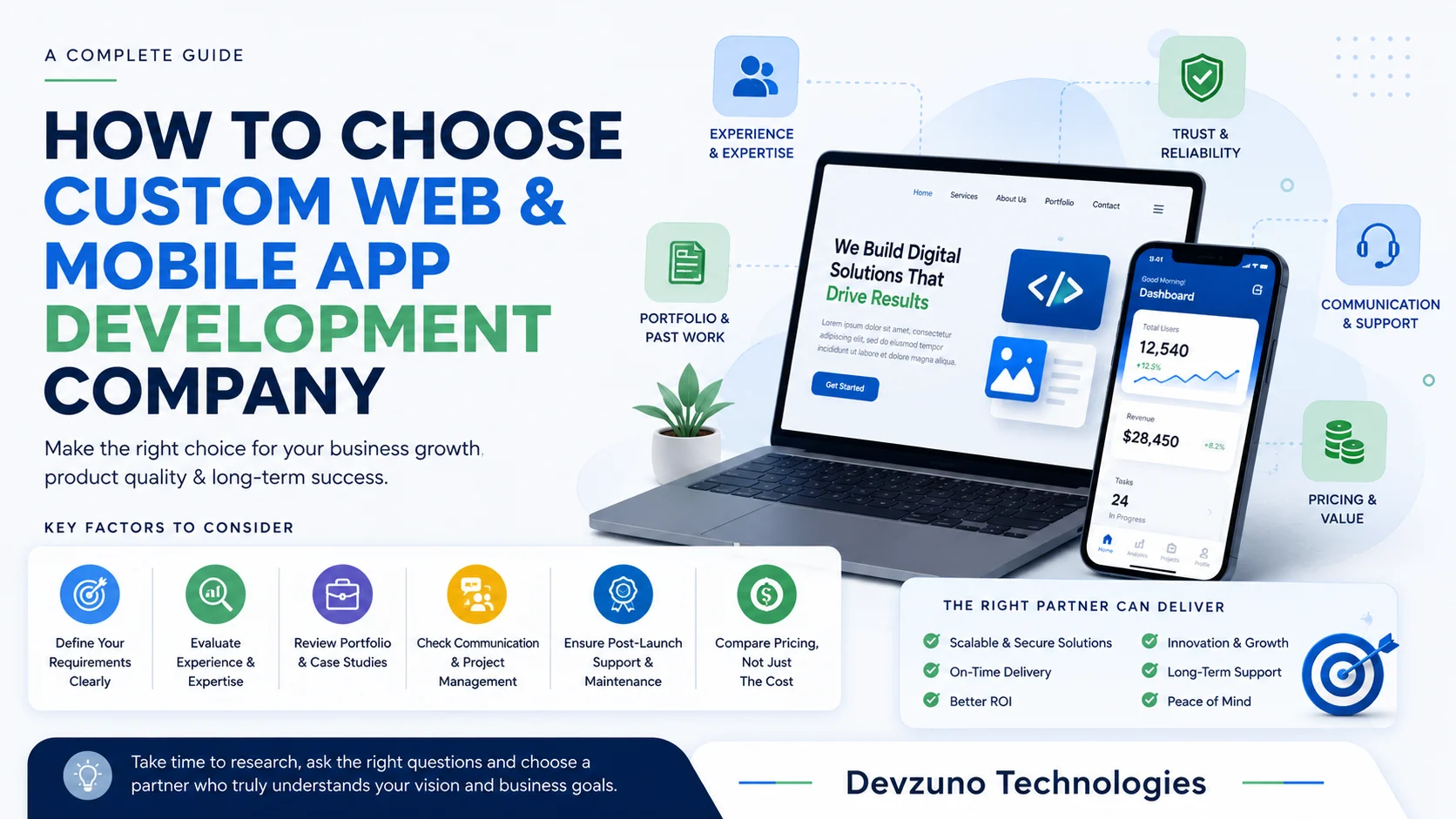
Choosing the right custom web and mobile app development company is one of the most critical decisions a founder, CTO, or business owner can make in 2026. A great engineering partner turns your vision into a scalable, high-converting digital product. Conversely, partnering with the wrong software agency leads to budget overruns, buggy code, missed launch deadlines, and lost intellectual property rights.
With thousands of software agencies, offshore vendors, and freelance teams claiming to build world-class applications, how do you separate true engineering experts from low-quality code shops?
In this comprehensive evaluation guide, we break down the 10 essential criteria for choosing a software development partner, reveal dangerous agency red flags, compare contract pricing models, provide a developer interview cheat sheet, and outline a 12-point checklist to ask before signing any software contract.
1. The High Stakes of Choosing a Software Development Partner
In 2026, software is no longer just an administrative utility—it is the central nervous system of your business. Whether you are building a custom customer mobile app, an automated e-commerce web portal, or an AI-driven enterprise dashboard, software quality directly impacts your user retention and bottom-line revenue.
Industry data shows that nearly 65% of software outsourcing failures stem from misaligned technical expectations, poor communication, or lack of code ownership clauses.
[Wrong Agency Choice]  --> Buggy Code -> Scope Creep -> Delayed Launch -> High Refactoring Costs
[Right Agency Partner] --> Clean Code -> Agile Demos  -> On-Time Launch -> Scalable ROI Growth
To protect your capital and ensure successful delivery, you need a systematic framework to evaluate potential technology partners.
2. 10 Critical Criteria to Evaluate a Software Development Company
Before awarding your web or mobile app project to an agency, evaluate them across these 10 non-negotiable standards:
1. Modern Tech Stack & Engineering Architecture
Ensure your development team uses modern, high-performance tech stacks aligned with your specific business goals:
- Mobile App Engineering: Cross-platform Flutter (Dart) or React Native for 60-120 FPS performance across iOS and Android, or Native Swift/Kotlin.
- Web Application Engineering: Astro, Next.js, React, or Node.js/Go microservices for sub-second page loads and perfect Google search indexing.
- Database & Cloud DevOps: PostgreSQL, Supabase, Redis, AWS, and Docker containerization.
2. Verified Portfolio & Real Working Case Studies
Do not rely solely on static design mockups on an agency website. Ask for:
- Live App Store & Play Store Links: Download and test their published mobile apps on physical devices to evaluate smooth scrolling, load speeds, and UI polish.
- Live Web Application URLs: Test their web portals on mobile and desktop browsers to verify responsiveness and performance.
- Technical Case Studies: Reviewing detailed documentation of how they solved complex technical challenges (e.g., real-time GPS tracking, payment gateway integration, database scaling).
3. Client Reviews & Independent Testimonials
Inspect independent review platforms such as Clutch, GoodFirms, Google Business Reviews, and LinkedIn:
- Look for feedback regarding deadline discipline, communication transparency, and post-launch support.
- Request to speak directly with 1 or 2 past clients for high-budget enterprise projects.
4. Transparent Pricing & Milestone-Based Payment Terms
A professional software agency provides a clear, itemized breakdown of costs in Indian Rupees (₹) or USD ($) rather than vague lump-sum quotes:
- Milestone Payments: Payments should be linked to verifiable deliverables (e.g., UI/UX approval, Alpha build, Beta test, App Store submission).
- No Hidden Fees: Clear policies on server setup costs, third-party API licenses, and post-launch maintenance.
5. 100% Code Ownership & Intellectual Property (IP) Rights
Ensure your contract explicitly states that you own 100% of the source code, design assets, database schemas, and intellectual property from day one:
- You must have direct access to the GitHub/GitLab repository throughout development.
- Avoid agencies that hold source code hostage or charge additional license fees to hand over the codebase.
6. Agile Development Methodology & Weekly Demos
Modern software development requires flexibility and continuous feedback loops:
- Sprint Demos: Your agency should provide working build demos every 1 to 2 weeks so you can test new features in real-time.
- Project Management Tools: Transparent tracking via Jira, Trello, or ClickUp, paired with direct communication channels on Slack or WhatsApp.
7. Post-Launch SLA & Maintenance Guarantees
Software development does not end on launch day. Every mobile OS update (iOS / Android) and cloud environment requires ongoing maintenance:
- Verify that your agency offers a 30-to-90 day complimentary post-launch bug fix warranty.
- Check if they offer predictable monthly/annual maintenance SLAs (Service Level Agreements) for server monitoring and security patches.
8. Cybersecurity & Data Protection Standards
Data breaches and API vulnerabilities can destroy customer trust:
- Ensure the team implements SSL Pinning, AES-256 database encryption, and secure OAuth 2.0 / JWT user authentication.
- Compliance readiness for standards like GDPR, HIPAA, or Indian DPDP Act (Digital Personal Data Protection).
9. Code Quality & Automated QA Testing
Writing clean, modular, and well-documented code prevents future software debt:
- Automated linting, unit testing, and continuous integration (CI/CD) pipelines.
- Physical device matrix testing across multiple iPhone and Android screen resolutions.
10. Business Understanding & Strategic ROI Focus
The best software company does not just write code passively—they act as product strategists who understand your business goals, target audience, and customer conversion funnels.
3. The 5-Phase Agency Evaluation Protocol
To make your selection process stress-free and bulletproof, follow this 5-phase evaluation protocol:
Phase 1: Initial Technical Screening & Portfolio Audit
Filter out low-quality vendors by auditing live app links, company registration history, and client reviews on Clutch and Google.
Phase 2: NDA Signing & Scope Discovery Session
Sign a mutual Non-Disclosure Agreement (NDA) before sharing sensitive business ideas. Conduct a 45-minute technical discovery call to evaluate if the team understands your business workflows.
Phase 3: RFP (Request for Proposal) & Technical Architecture Review
Request a detailed technical proposal outlining chosen tech stack, database schemas, third-party API dependencies, timeline milestones, and itemized cost breakdown in INR / USD.
Phase 4: Developer Interview & Code Sample Review
Interview the actual tech lead or senior developers assigned to your project. Ask practical questions regarding state management, API security, and database indexing.
Phase 5: Contract Signing, IP Transfer Clause & Project Kickoff
Review the legal contract ensuring 100% IP assignment, 30-90 day bug warranty, defined milestone payment schedules, and clear dispute resolution terms.
4. Developer Interview Cheat Sheet (For Non-Technical Founders)
If you are a non-technical founder interviewing a software development agency, ask these 5 technical questions to test their true engineering expertise:
| Question | Good Answer (What Experts Say) | Red Flag Answer (What Low-Quality Shops Say) |
|---|---|---|
| 1. How do you manage state in Flutter/React? | “We use BLoC or Riverpod for Flutter, and Redux Toolkit or Zustand for React to keep state predictable and separate from UI.” | “We just use basic SetState everywhere in the UI files.” (Leads to laggy, buggy UI). |
| 2. How do you secure API keys in mobile apps? | “We store secrets in environment variables, use SSL Pinning, and never hardcode API keys directly in client app code.” | “We paste the keys inside the app code, nobody can see it anyway.” (High security vulnerability). |
| 3. How do you test app performance across devices? | “We run automated integration tests and test physical builds on low-end Android phones and flagship iPhones.” | “We test on our laptop simulator/emulator.” |
| 4. How do you structure database queries for scale? | “We write normalized PostgreSQL schemas, add indexes to frequent foreign keys, and use Redis RAM caching for hot queries.” | “We store everything as unstructured JSON blobs without indexes.” |
| 5. How is code handed over to us? | “You will have admin access to the private GitHub repo from day one, with automated CI/CD deployment pipelines.” | “We will email you a ZIP file of code after final payment.” |
5. Dangerous Red Flags to Avoid When Hiring an Agency
Watch out for these common warning signs during your initial consultations:
❌ RED FLAG 1: Unreasonably cheap quotes ("₹15,000 for a complex full feature marketplace app")
❌ RED FLAG 2: Refusal to sign an NDA (Non-Disclosure Agreement) or IP Transfer Agreement
❌ RED FLAG 3: "Yes to Everything" syndrome (No technical pushback or architectural advice)
❌ RED FLAG 4: Black-box development (No Git access, no weekly demos, poor communication)
❌ RED FLAG 5: Absence of a dedicated QA testing team (Developers testing their own code)
6. Comparing Hiring Models: In-House vs. Freelancers vs. Software Agency
Choosing the right hiring model depends on your budget, project scale, and internal technical capability:
| Metric | Freelancers | In-House Engineering Team | Specialized Software Agency (Devzuno) |
|---|---|---|---|
| Upfront Cost | Low (₹15,000 – ₹80,000) | Extremely High (Salaries, Benefits, HR) | Optimized & Predictable (Milestone-based) |
| Skill Breadth | Limited to 1 developer skill | Limited to hired headcount | Full Team (UI/UX, Mobile, Web, DevOps, QA) |
| Delivery Speed | Slow & Unpredictable | Moderate | Fast (Pre-built CI/CD & Modular components) |
| Code Ownership & IP | High risk of lost access | 100% Full Control | 100% Guaranteed via Contract |
| Post-Launch Maintenance | High risk of freelancer ghosting | High overhead cost | Structured SLA & Warranty |
7. Software Pricing Models: Fixed Price vs. Dedicated Team
Choosing the correct contract model prevents budget overruns and scope disputes:
A. Fixed-Price Milestone Contract (Best for Defined Scope)
- Ideal For: Projects with a clear Product Requirement Document (PRD), wireframes, and defined features (e.g., ₹10,000 business websites up to ₹5 Lakh custom Flutter apps).
- Advantages: Clear upfront price, defined delivery timelines, and minimal financial risk for the client.
B. Dedicated Team / Time & Materials (Best for Evolving Products)
- Ideal For: High-growth startups and enterprises building complex SaaS portals or AI platforms where features evolve based on user feedback.
- Advantages: Complete flexibility to reprioritize features in weekly sprints, dedicated engineering capacity.
8. The 12-Point Checklist to Ask Before Signing a Contract
Before making your final selection, ask your prospective development agency these 12 direct questions:
- Which exact frameworks and databases will you use for my project?
- Can you share live links to 3 similar mobile apps or web portals you built?
- Will I have direct access to the GitHub source code repository from day one?
- Do I own 100% of the Intellectual Property (IP) and design assets upon milestone payments?
- How frequently will working build demos be delivered for testing?
- Which project management tools (Slack, Jira, Trello) will we use to communicate daily?
- How do you handle scope changes or new feature additions mid-project?
- What automated and physical device testing procedures do you execute before release?
- What is included in your post-launch bug warranty and support SLA?
- Will you assist with Apple App Store and Google Play Store publishing and review approvals?
- Who will be my primary point of contact (Project Manager / Tech Lead)?
- Can you provide a detailed itemized breakdown of milestones and costs in INR / USD?
9. Frequently Asked Questions (FAQ) for Agency Selection
Q1. Is it necessary to sign an NDA before hiring a development agency?
Yes, absolutely. Signing a mutual Non-Disclosure Agreement (NDA) is a mandatory step before sharing any proprietary business idea, workflow, or financial roadmap.
Q2. How are project delays handled if an agency fails to deliver on time?
Your contract should contain clear milestone deadlines and delivery commitments. At Devzuno, we adhere to strict milestone-based delivery, meaning payments are released only after you test and approve each completed milestone.
Q3. What are the main risks of hiring unverified offshore developers?
Hiring unverified freelancers carries risks of unmaintainable code, communication gaps, and security vulnerabilities. Partnering with an established software engineering firm like Devzuno Technologies eliminates these risks by providing 100% Git transparency, legal contracts, and dedicated technical project managers.
Q4. Will the agency handle store publishing on our Developer accounts?
Yes. A professional development agency manages the entire setup, configuration, and app submission process directly on your Apple Developer Account and Google Play Console.
10. Why Devzuno is the Trusted Software Partner for Startups & Enterprises
At Devzuno Technologies, we engineer high-performance web applications, mobile apps, and custom software systems designed to scale and generate measurable ROI. Here is why clients choose Devzuno:
- 100% Source Code & IP Ownership: You own every line of code, design asset, and database schema from day one.
- Cross-Platform Engineering Mastery: Industry-leading expertise in Flutter, React, Astro, Node.js, Go, and Cloud DevOps.
- Transparent Milestone Contracts: Clear, itemized pricing in INR (₹) starting from budget business websites (₹10,000) to custom mobile apps and enterprise software.
- Sub-Second Performance & Clean Architecture: Built for ultra-fast load times, fluid 60-120 FPS mobile experiences, and top Google SEO rankings.
- Dedicated Post-Launch SLA Support: Comprehensive bug-fix warranty and ongoing maintenance support to keep your software running seamlessly.
Ready to Partner with an Expert Development Team?
Whether you are launching a new digital product or upgrading an existing software portal, our engineering team is ready to help you plan, design, and build your custom application.
👉 Contact Devzuno Technologies Today for a free technical consultation and a detailed project roadmap!