
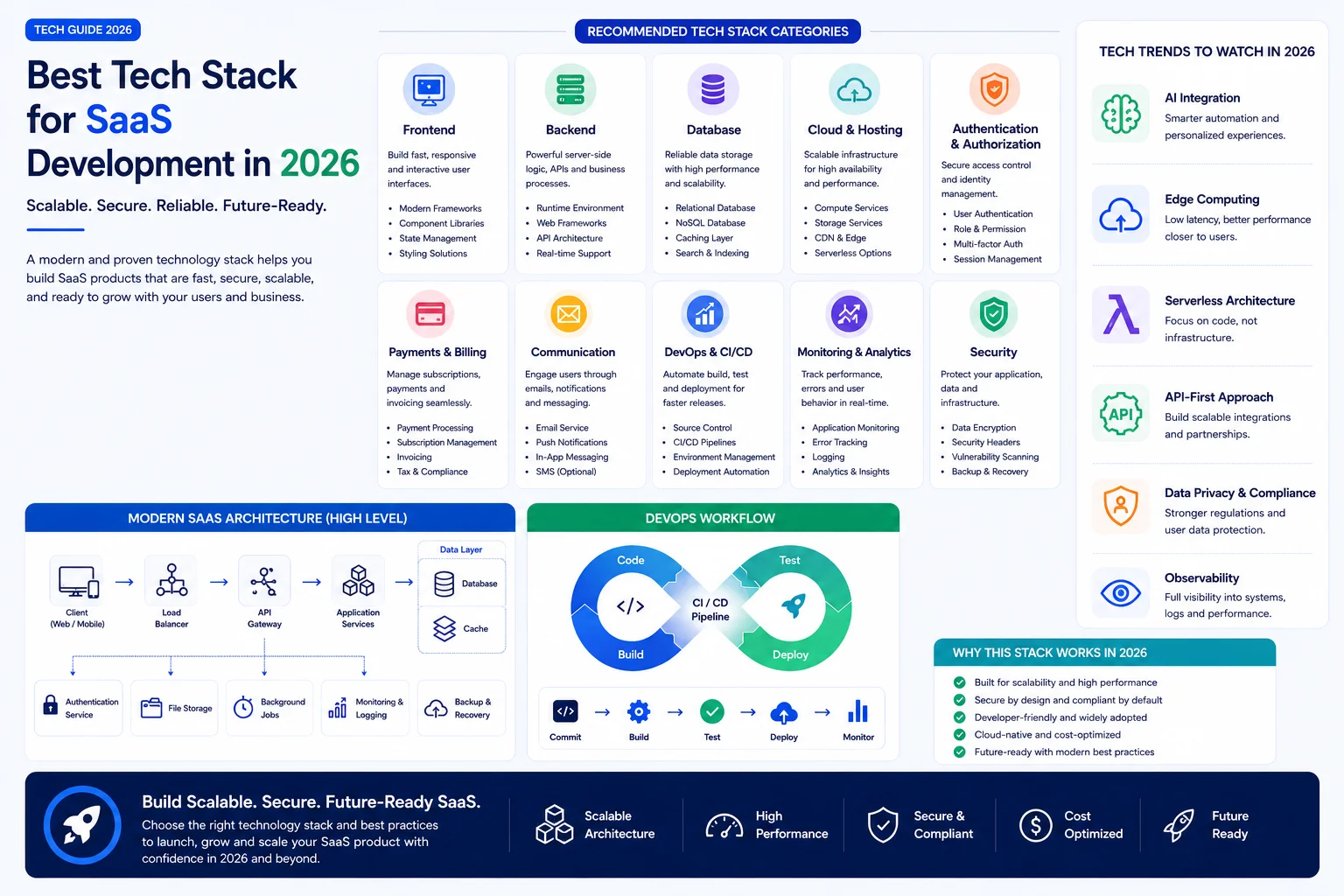
Selecting the optimal technology stack for a modern Software-as-a-Service (SaaS) platform is one of the most critical decisions a CTO, engineering founder, or software team will ever make.
The tech stack dictates not only your platform’s initial speed to market and development cost, but also its long-term scalability, maintenance overhead, Core Web Vitals performance, security posture, and cloud hosting bills. In 2026, web engineering has moved past heavy legacy frameworks toward zero-JavaScript static generation (Astro), modern full-stack SSR (Next.js), high-concurrency microservices (Node.js & Go), PostgreSQL with Row-Level Security, and containerized cloud infrastructure (AWS).
Partnering with an expert engineering partner like Devzuno Technologies ensures your application is built on a battle-tested, future-proof stack capable of serving millions of monthly active users at minimal infrastructure cost. Explore our SaaS Platform Development Services or our guide on Customizable ERP Dashboards & Systems.
1. The 2026 Web Engineering Landscape: Modern Demands
The web development landscape has undergone a radical transformation. Users no longer tolerate slow page loads, janky client-side hydration delays, or bloated 5MB JavaScript bundles.
The 4 Pillars of a 2026 Production-Grade SaaS Stack:
- Sub-Second Performance & Core Web Vitals: Delivering Largest Contentful Paint (LCP) under 1.2 seconds and Interaction to Next Paint (INP) under 100ms.
- SEO & LLM Indexability: Serving clean, semantic HTML directly from the server so Google Bots and AI engines (ChatGPT, Perplexity) can crawl and index content effortlessly.
- Developer Velocity & Type Safety: Utilizing end-to-end TypeScript to catch runtime bugs during compilation rather than in production.
- Cloud Infrastructure Cost Efficiency: Avoiding expensive per-bandwidth hosting lock-ins by deploying containerized microservices on auto-scaling AWS infrastructure.
2. Frontend Framework Battle: Astro vs. Next.js vs. React SPA
The frontend layer is what your users interact with directly. Choosing between Astro, Next.js, and traditional React Single Page Applications (SPA) depends on page dynamic requirements:
┌───────────────────────────────────────────────────────────────────────────┐
│                     FRONTEND FRAMEWORK SELECTION MATRIX                   │
├──────────────────────────┬──────────────────────┬─────────────────────────┤
│ Use Case                 │ Recommended Framework│ Primary Reason          │
├──────────────────────────┼──────────────────────┼─────────────────────────┤
│ Marketing & Blogs        │ Astro                │ Zero-JS default, 100/100 Lighthouse speed│
│ Web Portals & Dashboards │ Next.js / React      │ Rich client state & interactivity │
│ Mobile Apps              │ Flutter              │ 60-120 FPS native compilation           │
└──────────────────────────┴──────────────────────┴─────────────────────────┘| Evaluation Dimension | Astro | Next.js (App Router) | Traditional React SPA (Vite) |
|---|---|---|---|
| Rendering Strategy | Server-First Static (SSG) + Partial Hydration | Server-Side Rendering (SSR) + React Server Components | Client-Side Rendering (CSR) |
| Default JS Bundle Size | 0 KB (Island Architecture) | 85 KB – 250 KB Base | 350 KB – 1.5 MB Heavy Bundle |
| Google PageSpeed Score | 95 – 100 / 100 Guaranteed | 80 – 95 / 100 | 45 – 70 / 100 |
| SEO & LLM Crawlability | Maximum (Instant static HTML) | Excellent | Poor (Requires JS execution) |
| Build Time & Speed | Ultra-Fast (Vite powered) | Moderate (Webpack/Turbopack) | Fast |
| Best For | Content Portals, Marketing Sites, Blogs, Documentation | Interactive Dashboards, Complex Web Apps, E-Commerce | Simple Internal Tools behind login |
Why Devzuno Uses Astro for High-Ranking Portals
Astro’s Islands Architecture renders HTML on the server and ships zero client-side JavaScript by default. Interactive UI components (like a search filter or lead modal) are hydrated independently only when they scroll into view. This guarantees perfect 100/100 Google PageSpeed scores, giving platforms an immediate organic ranking advantage over competitors.
3. Micro-Frontends vs. Monolithic Frontend Architecture
As software development teams grow beyond 15 developers, maintaining a single monolithic frontend repository can slow down deployment velocity:
- Monolithic Frontend (Best for Early & Mid-Tier Platforms): A unified Astro or Next.js repository containing all marketing pages, blogs, and app dashboards. Simplifies deployment and shared design token reuse.
- Micro-Frontends (Best for Large Enterprises): Decoupling the application into distinct micro-apps (e.g., Marketing site on Astro, App Dashboard on Next.js, Checkout on React). Hosted independently on separate subdomains or reverse proxies for independent deployment pipelines.
4. End-to-End Type Safety (TypeScript, Zod & Prisma / tRPC)
Catching bugs during developer compilation rather than in production is critical for software reliability. Devzuno implements strict end-to-end type safety across the entire stack:
[PostgreSQL Database Schema] ➔ [Prisma / Drizzle ORM Types] ➔ [Zod Validation Specs] ➔ [Frontend UI Component Props]- Zod Runtime Schema Validation: Validating incoming API payloads, user inputs, and environment variables at runtime with zero extra dependencies.
- ORM Type Inference (Prisma / Drizzle): Automatically generating TypeScript types directly from your SQL database schema. If a database column name changes, TypeScript flags all frontend references as compile-time errors.
- tRPC / GraphQL Data Fetching: Eliminating manual API contract authoring by allowing frontend components to consume backend API functions directly with full TypeScript autocompletion.
5. State Management & Server State Caching (TanStack Query & Zustand)
State management bugs are a major source of customer frustration in web applications. Modern web engineering separates Server State from Local UI State:
- TanStack Query (React Query): Manages all server data fetching, automatic background revalidation, optimistic UI updates, and intelligent caching. Eliminates redundant API calls and keeps client data synchronized automatically.
- Zustand / Jotai: Lightweight, unopinionated local client state management (e.g., managing sidebar toggle states, modal open/close states, and temporary draft form inputs) without the massive boilerplate of legacy Redux.
6. Styling & Design System Architecture (Vanilla CSS & CSS Tokens)
CSS architecture dictates site rendering speed and maintainability. While many teams default to heavy utility frameworks, Devzuno enforces modern CSS best practices:
- CSS Custom Properties (Design Tokens): Defining global color palettes, typography scales, spacing tokens, and border radii using native CSS variables (
var(--devzuno-blue)). - Scoped CSS & Lightning CSS: Writing clean, scoped Vanilla CSS modules compiled via Lightning CSS for sub-millisecond build speeds and zero runtime CSS-in-JS overhead.
- Fluid Layouts (CSS Grid & Flexbox): Utilizing native CSS
clamp(), Grid, and Flexbox for smooth responsiveness across mobile, tablet, and ultra-wide desktop displays without bloated media query overrides.
7. Backend Runtime Evaluation: Node.js vs. Go vs. Python
The backend runtime processes business logic, communicates with databases, manages authentication, and executes async background tasks:
┌───────────────────────────────────────────────────────────────────────────┐
│                      BACKEND MICROSERVICES ECOSYSTEM                      │
│                                                                           │
│   ┌────────────────────────┐  ┌────────────────────────┐  ┌──────────────┐  │
│   │ Node.js (TypeScript)   │  │       Go (Golang)      │  │Python FastAPI│  │
│   │  API Gateway & Auth    │  │  High-Concurrency Jobs │  │AI Models & RAG│  │
│   └────────────────────────┘  └────────────────────────┘  └──────────────┘  │
└───────────────────────────────────────────────────────────────────────────┘
A. Node.js (TypeScript) — The Universal Enterprise Standard
- Strengths: Non-blocking asynchronous I/O event loop, massive npm library ecosystem, shared TypeScript types across frontend and backend.
- Best For: RESTful & GraphQL API gateways, real-time WebSockets, auth services, and general business workflows.
B. Go (Golang) — High-Performance Concurrency Engine
- Strengths: Native goroutines for lightweight concurrent processing, sub-millisecond execution times, compiled single binary deployment, minimal RAM consumption (~15MB base RAM).
- Best For: High-volume payment gateways, microservice backends, data processing pipelines, and fleet tracking systems.
C. Python (FastAPI / Django) — AI & Data Engineering Powerhouse
- Strengths: Native integration with AI/ML frameworks (PyTorch, TensorFlow, LangChain, LlamaIndex, NumPy).
- Best For: Vector database RAG pipelines, custom AI agent orchestrators, machine learning models, and automated data science pipelines.
8. Database Architecture: PostgreSQL vs. MongoDB vs. Redis
Choosing the right database stack requires balancing relational consistency against unstructured data flexibility:
┌───────────────────────────────────────────────────────────────────────────┐
│                         POLYGLOT PERSISTENCE STACK                        │
├───────────────────────────────────┬───────────────────────────────────────┤
│ Relational Core Data (PostgreSQL) │ User accounts, Invoices, Tenant Schema│
│ Document Caching (Redis Cluster)  │ Active sessions, JWT tokens, Rate Limiting│
│ Unstructured Logs (MongoDB)       │ Activity audit streams, Webhook payloads│
└───────────────────────────────────┴───────────────────────────────────────┘
1. PostgreSQL (Primary Relational Engine)
- Why It Leads: PostgreSQL is the gold standard for enterprise databases. It combines ACID transactional reliability, Row-Level Security (RLS) for multi-tenancy, custom JSONB document support, and pgvector for embedded AI vector searches.
2. Redis (In-Memory Caching & Rate Limiting)
- Why It’s Essential: Operates as an in-memory key-value cache resolving queries in sub-5 milliseconds. Used for session management, API payload caching, sliding-window rate limiting, and pub/sub messaging.
3. MongoDB (NoSQL Document Store)
- Why It’s Used: Flexible dynamic schemas ideal for unstructured logs, product catalogs with varying attributes, and multi-tenant event logging.
9. Cloud Infrastructure: AWS Containerized Stack vs. Serverless
Where and how you host your application determines server stability and infrastructure expenses as user traffic scales:
| Cloud Architecture | Technical Stack | Scalability | Monthly Cost Efficiency | Infrastructure Lock-In |
|---|---|---|---|---|
| AWS Containerized (Devzuno Recommended) | AWS EKS (Kubernetes) / ECS + Docker + Aurora PostgreSQL | Unlimited Enterprise Auto-Scaling | Highly Cost-Effective at Scale | Zero (Standard Docker containers portable to any cloud) |
| Vercel / Netlify PaaS | Serverless Edge Functions | Automatic | Expensive at High Traffic (Bandwidth markup) | Moderate (Proprietary serverless wrapper runtime) |
| Traditional VPS (DigitalOcean / Linode) | Monolithic Nginx + Single Server | Manual Scaling | Low Initial Cost; Breaks under spikes | High Manual Ops Burden |
The Devzuno AWS Production Infrastructure Blueprint:
[Route 53 DNS & Cloudflare WAF] ➔ [AWS Application Load Balancer (ALB)] ➔ [AWS ECS / EKS Container Cluster] ➔ [AWS Aurora PostgreSQL Serverless v2] ➔ [Redis ElastiCache]10. Serverless Database Pooling & Edge Performance
When connecting serverless edge functions to relational databases, managing active connections requires specialized proxy architecture:
- Neon / Supabase / AWS RDS Proxy: Serverless database proxies that manage connection pooling automatically, allowing thousands of ephemeral edge functions to query PostgreSQL without exceeding database connection limits.
11. Edge Computing & CDN Caching Strategies (Cloudflare Workers)
Deploying server logic closer to users reduces geographic network latency:
- Global Edge CDN (Cloudflare / CloudFront): Serving static HTML assets, images, and WebP graphics from 300+ edge locations worldwide.
- Edge HTTP Caching Headers: Implementing granular
Cache-Control: public, max-age=3600, stale-while-revalidate=86400headers so content updates render instantly while background workers refresh the cache.
12. Real-Time Communication & Event-Driven Architecture
Modern applications demand real-time interactivity. We implement event-driven architectures to deliver instant notifications without blocking primary thread execution:
- WebSockets (Socket.io / Native WS): Maintaining lightweight bidirectional persistent connections for live messaging, order status updates, and interactive notifications.
- Message Queues (BullMQ / AWS SQS / Kafka): Offloading heavy async tasks (such as processing PDF reports, sending batch emails, or processing video uploads) to background worker instances.
13. Security, Zero-Trust & DevOps Pipeline
Securing your tech stack requires defense-in-depth across code, network, and cloud layers:
A. Zero-Trust Security & Identity Verification
- mTLS & Internal Service Auth: Enforcing mutual TLS (mTLS) encryption for inter-microservice communication within Kubernetes clusters.
- JWT Token Rotation: Short-lived access tokens (15-min expiration) coupled with secure, HTTP-only refresh cookies.
- Rate Limiting & WAF: Protecting endpoints against DDoS attacks and brute-force attempts using Cloudflare Enterprise Web Application Firewall (WAF).
- Environment Secret Management: Encrypting application secrets using AWS Secrets Manager or HashiCorp Vault.
B. Automated CI/CD Pipelines
[Git Push to Main Branch] ➔ [GitHub Actions CI Pipeline] ➔ [Automated Unit & E2E Testing] ➔ [Build Docker Image] ➔ [Push to AWS ECR] ➔ [Zero-Downtime Deployment to AWS ECS]14. Continuous Cloud Cost Optimization (FinOps)
Cloud infrastructure costs can escalate if unmanaged. Devzuno implements FinOps practices:
- AWS Graviton (ARM64) Instances: Utilizing AWS Graviton 3 processor nodes in EC2/ECS clusters to achieve 40% better price-performance compared to traditional x86 instances.
- Auto-Stopping Staging Environments: Automated Lambda scripts that shutdown non-production staging servers during off-business hours (7 PM to 7 AM), cutting staging cloud costs by 50%.
15. Real User Monitoring (RUM) & Performance Observability
Tracking actual user experience metrics in real time ensures issues are caught before clients complain:
- Real User Monitoring (Datadog / Sentry RUM): Capture actual browser field performance data (INP, LCP, CLS) from real users across different devices and geographic locations.
- OpenTelemetry Distributed Tracing: Instrumenting API requests to measure exact SQL query times, external HTTP calls, and template rendering latency.
16. Automated Testing & Developer Productivity Suite
High-velocity engineering teams rely on automated testing pipelines to prevent regression bugs:
- Vitest (Unit & Integration Testing): Ultra-fast unit testing framework executing thousands of test assertions in seconds.
- Playwright (End-to-End E2E Testing): Headless browser testing verifying critical user flows (login, payment checkout, profile updates) across Chrome, Firefox, and Safari before production releases.
- Husky & Lint-Staged: Pre-commit Git hooks enforcing ESLint formatting and TypeScript compilation checks automatically prior to code commits.
17. Real-World SaaS Architecture Performance Benchmarks
Below is a real-world benchmark comparison of a SaaS platform architecture optimization (migrating to modern edge rendering with Astro, Next.js, Node.js, and PostgreSQL):
| Performance Metric | Previous Server Architecture | Devzuno Modern Edge Stack | Improvement |
|---|---|---|---|
| Page Load Speed (LCP) | 4.8 seconds | 0.8 seconds | 6x Faster |
| Google PageSpeed Mobile Score | 38 / 100 | 98 / 100 | +157% Increase |
| API Latency (p99) | 650 ms | 45 ms | 14x Faster |
| Monthly AWS Infra Bill | $650 / month | $180 / month | 72% Cost Reduction |
18. Frequently Asked Questions (FAQs)
Q1. Why choose Astro over Next.js for content-heavy sites and blogs?
Astro ships 0 KB of client-side JavaScript by default using its Islands Architecture, rendering pure HTML on the server. This guarantees 95-100 Google PageSpeed scores. Next.js is better suited for highly dynamic dashboards behind authentication login portals.
Q2. Is Node.js fast enough for enterprise SaaS backends in 2026?
Yes! Node.js handles tens of thousands of concurrent I/O requests per second using its non-blocking event loop. For CPU-heavy mathematical computations or high-frequency real-time pipelines, we combine Node.js with Go (Golang) microservices.
Q3. Why use PostgreSQL over MongoDB for a new SaaS product?
PostgreSQL provides ACID transactional safety, complex relational joins, Row-Level Security (RLS) for multi-tenancy, JSONB document fields for unstructured data, and pgvector for AI search. It is the most versatile database engine available.
Q4. What is the advantage of hosting on AWS ECS/EKS containerized clusters instead of Vercel?
Vercel is great for early MVPs, but as web traffic grows, serverless bandwidth and execution pricing become extremely expensive. Containerized Docker deployments on AWS ECS or Kubernetes (EKS) offer predictable, fixed infrastructure costs that are up to 70% cheaper at scale.
Q5. How does Devzuno help us choose the right tech stack for our project?
Contact the principal architects at Devzuno Technologies. We audit your project requirements, user concurrency projections, security compliance needs, and budget to design a tailored technical stack blueprint.
Ready to Build a High-Performance SaaS Platform?
Build your next digital product on a battle-tested 2026 technology stack. 👉 Connect with Devzuno Software Architects Today to design your scalable SaaS infrastructure or explore our Custom Software Engineering Services.