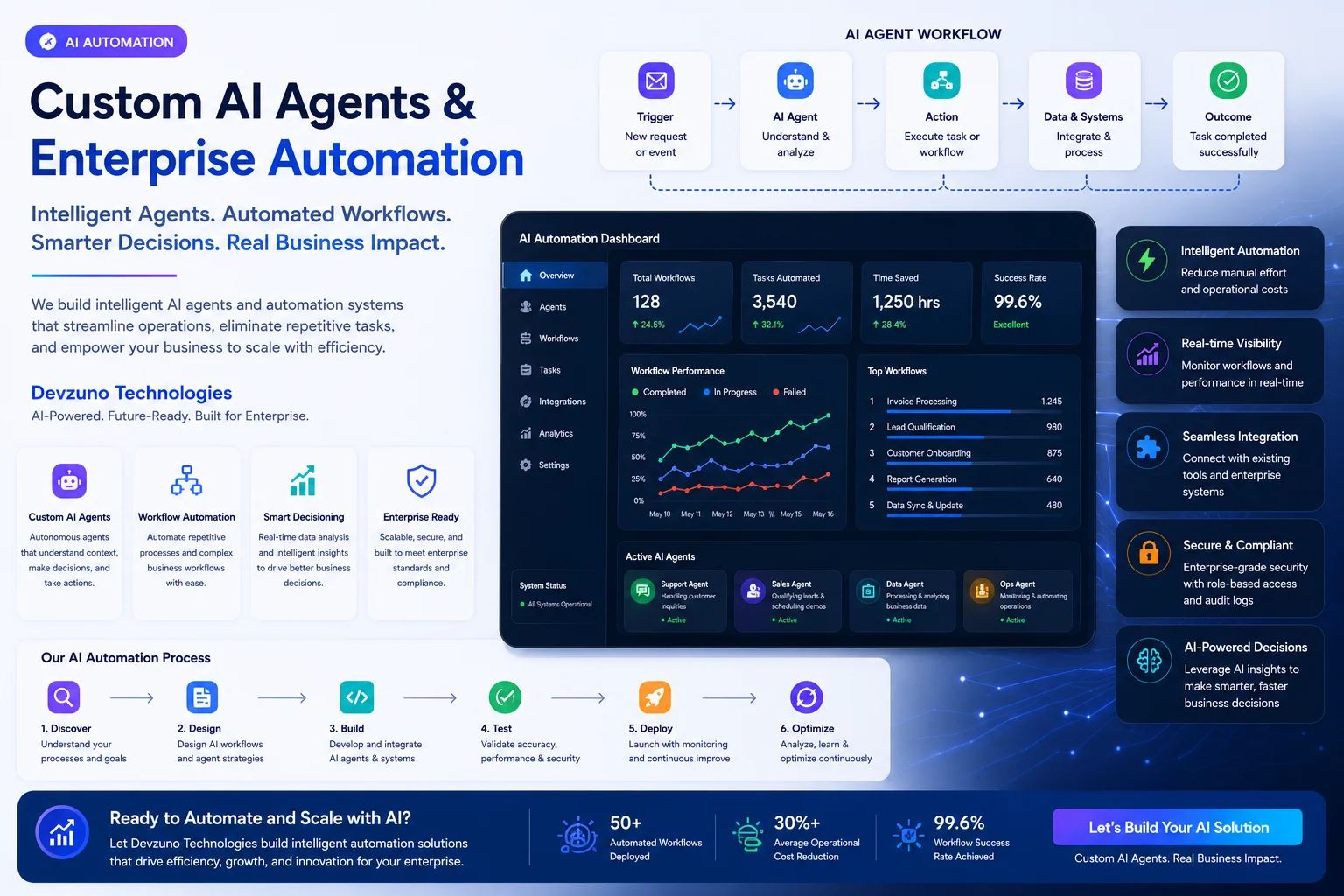
Artificial Intelligence has shifted from passive conversational text bots to autonomous Agentic AI. In 2026, forward-thinking enterprises, SaaS startups, and corporate brands are no longer satisfied with simple ChatGPT-like chatbots that merely answer text prompts. Modern enterprises require AI Agents—autonomous software entities capable of reasoning, planning multi-step tasks, executing API calls across internal ERP/CRM databases, and making decisions with minimal human intervention.
Partnering with a specialized AI software engineering partner like Devzuno Technologies enables companies to transition from manual, repetitive workflows to intelligent agentic automation. This comprehensive guide covers everything technical decision-makers, CTOs, and product leaders need to know about building, securing, and deploying enterprise-grade AI Agents.
1. The Paradigm Shift: Chatbots vs. Rule-Based Automation vs. AI Agents
To understand the business value of Agentic AI, we must first compare traditional software paradigms against modern autonomous agents:
| Feature / Metric | Traditional Rule-Based RPA (Zapier / UiPath) | Generative Chatbots (ChatGPT / Basic LLMs) | Autonomous Enterprise AI Agents |
|---|---|---|---|
| Execution Logic | Hardcoded if/else logic | Text generation based on prompt context | Dynamic planning, reasoning, & goal decomposition |
| Adaptability to Change | Breaks if API payload schema changes | Responds with text; cannot perform actions | Self-corrects, retries failed steps, and adapts |
| Tool & API Integration | Webhook triggers | Limited to basic web browsing plugins | Deep bidirectional execution across enterprise APIs |
| Memory & Context | Stateless | Conversation window memory | Short-term working memory + Long-term Vector DB |
| Decision Making | Zero decision capability | Text recommendations only | Autonomous decision-making within safety guardrails |
| Primary Business Value | Simple data transfer | Quick Q&A assistance | End-to-End Workflow Automation & Cost Reduction |
2. Anatomy & Core Architecture of an Enterprise AI Agent
An enterprise-ready AI Agent is not a single script; it is a multi-component distributed system designed around five foundational modules:
┌───────────────────────────────────────────────────────────────────────────┐
│                           1. PERCEPTION MODULE                            │
│           (Processes User Inputs, System Triggers, Webhooks & Logs)       │
└─────────────────────────────────────┬─────────────────────────────────────┘
                                      │
                                      ▼
┌───────────────────────────────────────────────────────────────────────────┐
│                        2. REASONING & PLANNING ENGINE                     │
│      (LLM Brain: Task Decomposition, ReAct Prompting, Reflection Loops)   │
└───────────────────────────┬───────────────────┬───────────────────────────┘
                            │                   │
                            ▼                   ▼
┌──────────────────────────────────┐  ┌──────────────────────────────────┐
│        3. MEMORY SYSTEM          │  │     4. TOOLS & EXECUTION         │
│  - Working Memory (Context)      │  │  - Enterprise REST / GraphQL APIs│
│  - Long-Term Vector Database     │  │  - SQL Database Query Engine     │
│    (Pinecone / Qdrant / Pgvector)│  │  - File Processors & Web Scrapers│
└──────────────────────────────────┘  └──────────────────────────────────┘
                                      │
                                      ▼
┌───────────────────────────────────────────────────────────────────────────┐
│                        5. GUARDRAILS & EVALUATION                         │
│            (PII Redaction, Rate Limits, Human-in-the-Loop Approval)       │
└───────────────────────────────────────────────────────────────────────────┘
A. The Reasoning & Planning Engine (The Brain)
Using Advanced Prompt Engineering techniques such as ReAct (Reason + Act) and Tree-of-Thoughts (ToT), the agent breaks complex business goals into sub-tasks. For example, if a user requests: “Audit last month’s unpaid vendor invoices and send reminders,” the agent breaks this down into:
- Querying the ERP database for unpaid invoices.
- Filtering invoices older than 30 days.
- Fetching vendor contact details from the CRM.
- Drafting personalized email reminders.
- Requesting human manager approval before dispatching emails.
B. Memory Systems (Short-Term & Long-Term)
- Working Short-Term Memory: Stores immediate task state and conversation context using Redis or in-memory stores.
- Long-Term Vector Memory: Stores historical company documents, policies, and past interaction resolution patterns using vector databases like pgvector (PostgreSQL), Pinecone, or Qdrant.
C. Tool & Function Calling Layer
Agents interact with the real world through standardized API interfaces (OpenAPI specifications). The LLM outputs structured JSON function calls which the agent’s runtime environment executes safely against backends (e.g., Salesforce, HubSpot, SAP, Stripe, Slack, PostgreSQL).
D. Safety Guardrails & Human-In-The-Loop (HITL)
Enterprise systems require strict boundaries. Critical financial actions (e.g., executing transactions above ₹50,000) trigger a Human-in-the-Loop checkpoint where an administrative approval is required via Slack or Email before execution resumes.
3. Multi-Agent Communication Patterns (Orchestrator-Worker vs. Swarm)
In complex enterprise operations, reliance on a single monolithic AI Agent can lead to context overload. Advanced systems deploy Multi-Agent Architectures where specialized agents collaborate:
                      ┌──────────────────────────┐
                      │    Orchestrator Agent    │
                      │  (Planner & Dispatcher) │
                      └─────────────┬────────────┘
                                    │
       ┌────────────────────────────┼────────────────────────────┐
       ▼                            ▼                            ▼
┌──────────────┐             ┌──────────────┐             ┌──────────────┐
│ Researcher   │             │   SQL Data   │             │ Compliance & │
│  Agent (RAG) │             │ Query Agent  │             │ Audit Agent  │
└──────────────┘             └──────────────┘             └──────────────┘
A. Orchestrator-Worker Architecture
A central Supervisor Agent receives user requests, breaks them down into sub-tasks, delegates each task to domain-specific worker agents (e.g., SQL Query Agent, Fraud Detection Agent, Email Generator Agent), aggregates their outputs, and performs quality reflection before returning the response.
B. Peer-to-Peer Agent Swarms
Worker agents pass control back and forth dynamically using stateful message queues (Kafka / RabbitMQ), ideal for open-ended research and autonomous problem-solving workflows.
4. Technology Stack & Framework Evaluation
Selecting the right framework for agent orchestration determines system reliability and developer velocity:
| Framework | Best Suited For | Key Strengths | Considerations |
|---|---|---|---|
| LangGraph (by LangChain) | Stateful, Multi-Agent Workflows | Graph-based state machine, cycle support, time-travel debugging | Steep learning curve for complex graphs |
| CrewAI | Role-Based Collaborative Agents | Extremely simple syntax, role assignment (e.g., Researcher, Writer) | Less granular control over low-level execution |
| Microsoft AutoGen | Multi-Agent Conversational Simulation | Excellent for code execution and multi-agent debate | Requires strict sandbox execution environments |
| LlamaIndex | Complex Document RAG & Data Agents | Unrivaled indexing algorithms for unstructured PDFs and SQL | Focused primarily on data retrieval workflows |
At Devzuno, we primarily utilize LangGraph and LlamaIndex combined with custom Python / Node.js runtimes to build production-grade, stateful multi-agent systems with zero vendor lock-in.
5. Enterprise Retrieval-Augmented Generation (RAG) Architecture
For an AI Agent to answer queries accurately using proprietary company documents without hallucinating, a modern Advanced RAG Pipeline is mandatory:
[Document Ingestion (PDF/Docs/SQL)] ➔ [Chunking & Embedding (OpenAI/Cohort)] ➔ [Vector Indexing (pgvector)] ➔ [Hybrid Search (Dense + Sparse BM25)] ➔ [Reranking (Cohere Rerank)] ➔ [LLM Synthesis]Key RAG Optimizations Implemented by Devzuno:
- Semantic Chunking: Splitting raw text based on sentence semantics rather than arbitrary character lengths.
- Hybrid Search (Dense Vector + Sparse Keyword): Combining vector semantic similarity with BM25 keyword matching to catch exact SKU numbers or invoice IDs.
- Reranking Models: Passing search results through a secondary Cross-Encoder model (such as Cohere Rerank) to prioritize top-3 relevant document snippets before feeding them to the LLM.
6. Top 6 Enterprise Use-Cases for Autonomous AI Agents
AI Agents deliver massive ROI when deployed to replace repetitive manual operational tasks across business divisions:
1. Automated Customer Support & Order Resolution Agents
- Capabilities: Resolves customer inquiries, processes refund requests directly through Shopify/Stripe APIs, updates delivery addresses, and escalates complex issues to human support teams.
- Impact: 70% reduction in customer support ticket volume and 24/7 instant response times.
2. Enterprise Knowledge Retrieval & Internal Helpdesk Agents
- Capabilities: Indexes internal company wikis, HR policies, IT troubleshooting manuals, and legal contracts. Employees can ask complex questions in plain Hindi or English and receive instant, cited answers.
- Impact: Eliminates hours spent by employees searching through messy Google Drive or Sharepoint folders.
3. Automated Lead Qualification & B2B Outreach Agents
- Capabilities: Monitors incoming web form leads, queries LinkedIn/Apollo APIs to enrich lead company size and revenue data, scores the lead, and drafts personalized sales proposals.
- Impact: 4x faster sales response time and higher deal conversion rates.
4. Financial Auditing & Automated Reconciliation Agents
- Capabilities: Parses vendor invoices (PDFs), cross-references line items against purchase orders in ERP databases, detects discrepancies or duplicate billings, and flags them for finance team review.
- Impact: Prevents costly manual billing errors and accelerates month-end financial closing.
5. Supply Chain & Inventory Replenishment Agents
- Capabilities: Monitors stock levels across multiple warehouses, forecasts demand based on historical sales trends, and automatically generates purchase orders when inventory hits reorder thresholds.
- Impact: Minimizes stockouts and optimizes warehouse working capital.
6. DevOps & Infrastructure Monitoring Agents
- Capabilities: Scans server error logs in real-time, diagnoses root causes of application crashes, initiates auto-scaling scripts, and drafts incident post-mortem reports for engineering teams.
- Impact: Reduces Mean Time to Resolution (MTTR) for cloud system downtime.
7. Data Governance, Privacy & Security Safeguards
Data privacy is the single biggest concern when adopting AI in enterprise environments. Devzuno ensures strict compliance:
- Zero Data Retention Models: We utilize enterprise LLM endpoints (AWS Bedrock, Azure OpenAI Service, or Private Self-Hosted Models) where user data is never used to train base foundation models.
- Automated PII / PGI Redaction: Prior to sending any text payload to an LLM, sensitive data (Credit Card Numbers, Aadhaar IDs, Passwords, Phone Numbers) is automatically scrubbed using Microsoft Presidio or custom regex filters.
- Virtual Private Cloud (VPC) Deployment: AI Agent orchestrators and Vector DBs are deployed inside your secure AWS/Azure VPC with restricted IAM access controls.
- SOC 2 & HIPAA Compliance: Comprehensive audit logging tracking every agent action, LLM input prompt, tool execution payload, and output response.
8. Evaluation, Benchmarking & Red-Teaming Frameworks
Deploying an AI Agent to production requires strict continuous testing frameworks to eliminate hallucinations and prompt injection vulnerabilities:
┌───────────────────────────────────────────────────────────────────────────┐
│                       EVALUATION METRIC SUITE                             │
├───────────────────────────────────┬───────────────────────────────────────┤
│ Metric Name                       │ Target Benchmark Threshold            │
├───────────────────────────────────┼───────────────────────────────────────┤
│ Faithfulness (Ragas Framework)    │ > 0.95 (No hallucinated facts)        │
│ Context Precision                 │ > 0.90 (Relevant vector retrieval)    │
│ Tool Selection Accuracy           │ > 0.98 (Correct API called)           │
│ Prompt Injection Resistance       │ 100% Red-Teaming Immunity             │
└───────────────────────────────────┴───────────────────────────────────────┘
At Devzuno, we execute automated Red-Teaming suites that attempt to jailbreak the agent, force unintended tool executions, or extract system prompts before approving production deployments.
9. Step-by-Step Engineering Roadmap at Devzuno
Building an enterprise AI Agent requires a methodical software engineering lifecycle:
Phase 1: Workflow Audit & Feasibility Assessment (Week 1-2)
  └── Phase 2: Architecture & Data Ingestion Pipeline (Week 3-4)
        └── Phase 3: Agent Orchestration & Tool Binding (Week 5-7)
              └── Phase 4: Security Guardrails & Human-in-Loop UI (Week 8-9)
└── Phase 5: Evaluation, Benchmarking & Deployment (Week 10-12)- Workflow Audit & ROI Mapping: Identifying high-friction business bottlenecks and defining key performance indicators (KPIs).
- Data Pipeline & Vector Database Setup: Ingesting and indexing company databases, documentation, and legacy APIs.
- Agent Logic & Function Calling: Developing the state graph, system prompts, tool interfaces, and error-retry logic.
- Guardrails & Control UI: Building admin management portals allowing human supervisors to inspect agent execution logs and approve pending actions.
- Evaluation & Red-Teaming: Testing agent accuracy against adversarial inputs (prompt injection attacks) and measuring retrieval precision using Ragas frameworks.
- Deployment & Monitoring: Launching production agents on AWS Kubernetes (EKS) or Lambda with automated logging and cost telemetry monitoring.
10. Cost, ROI & Resource Allocation Breakdown
Investing in custom enterprise AI Agent development provides significant long-term operational savings. Below is an estimated cost and development timeframe guide:
| Solution Tier | Functional Capabilities | Timeline | Investment Range (INR) |
|---|---|---|---|
| Proof of Concept (PoC) Agent | Single-purpose RAG agent, basic API hook, simple admin UI | 3 - 4 Weeks | ₹2.5 Lakh – ₹4.5 Lakh |
| Standard Business AI Agent | Multi-tool integration, vector DB memory, custom guardrails | 6 - 10 Weeks | ₹5 Lakh – ₹10 Lakh |
| Enterprise Multi-Agent Platform | Autonomous multi-agent coordination, deep ERP integration, VPC setup | 10 - 16 Weeks | ₹11 Lakh – ₹20+ Lakh |
Operational ROI Example:
An enterprise spending ₹15 Lakhs annually on manual data entry and customer support operations can reduce operational expenses by 60% within the first 6 months of deploying an Agentic AI solution, achieving full payback on investment within 9 months.
11. Why Choose Devzuno Technologies for Enterprise AI Engineering
Devzuno Technologies is at the forefront of modern software and artificial intelligence development:
- AI-First Engineering Expertise: Deep domain expertise in LangChain, LangGraph, LlamaIndex, Python, Node.js, and Cloud AI Infrastructure.
- Custom Security-First Solutions: No generic wrapper apps. We engineer bespoke, enterprise-secured AI architectures tailored to your existing software stack.
- Transparent Code Ownership: 100% full source code ownership, model deployment rights, and infrastructure control passed directly to your organization.
- SLA-Backed Ongoing Support: Continuous prompt optimization, model evaluation, and software updates to keep pace with rapid AI advances.
12. Frequently Asked Questions (FAQs)
Q1. What is the difference between a traditional chatbot and an AI Agent?
A traditional chatbot only responds with text based on conversation history. An AI Agent can reason, plan complex multi-step workflows, autonomously execute database queries or API calls across external systems, and complete real-world tasks without manual human effort.
Q2. Is our proprietary company data safe when using AI Agents?
Yes. Devzuno builds enterprise AI solutions using private cloud models (AWS Bedrock, Azure OpenAI) or self-hosted open-source models (Llama 3, Mistral). Your company data is encrypted in transit and at rest, and is never used to train public LLM models.
Q3. What happens if an AI Agent makes a mistake or hallucinates?
We implement Human-in-the-Loop (HITL) workflows and strict confidence score validation. If an agent’s decision confidence falls below a set threshold or involves high-stakes financial operations, the action is paused and routed to a human admin for confirmation.
Q4. Can AI Agents integrate with legacy ERP or custom software systems?
Yes! As long as your legacy software exposes REST APIs, SOAP endpoints, SQL database connections, or webhooks, our AI Agents can safely read data and trigger actions across your infrastructure.
Q5. How do you measure the accuracy of an Enterprise AI Agent?
We utilize automated LLM evaluation frameworks (such as Ragas and TruLens) to continuously benchmark Faithfulness, Answer Relevance, Context Precision, and Tool Calling Accuracy against ground-truth datasets.
Q6. How do we get started with building an AI Agent for our business?
Contact the AI engineering team at Devzuno Technologies to schedule an initial discovery consultation. We will audit your current workflow bottlenecks and provide a customized technical roadmap and feasibility proposal.
Ready to Automate Your Business with Enterprise AI Agents?
Unlock unprecedented operational efficiency with custom Agentic AI workflows. Reach out to Devzuno Technologies today to consult with our lead AI software architects.