
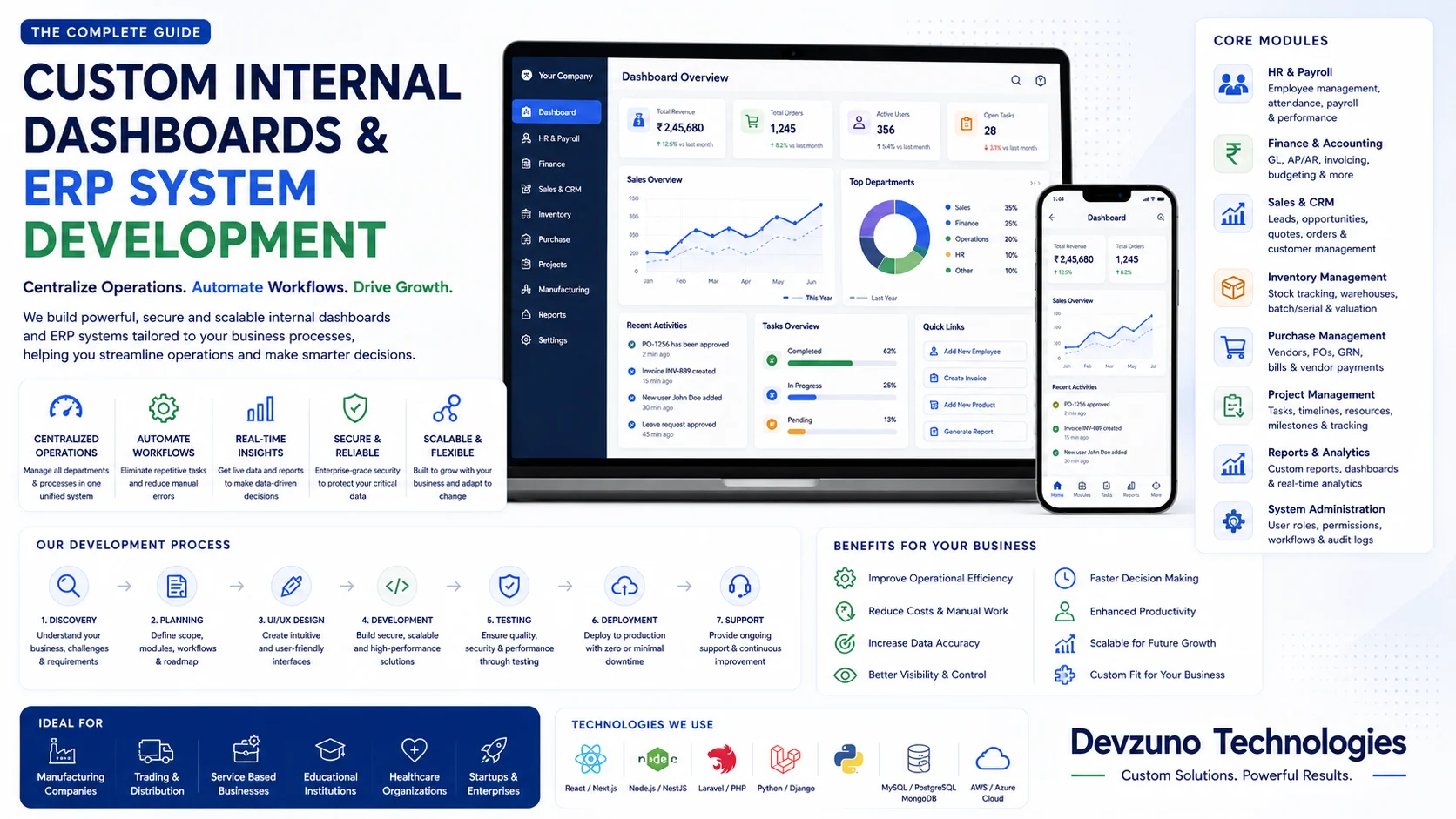
In 2026, growing enterprises, manufacturing conglomerates, multi-branch retail networks, and tech-driven organizations across India and globally face a common operational challenge: How to centralize disparate business operations into high-speed ERP software with customizable dashboards and real-time visibility.
As companies scale past 50 employees or multiple operating branches, managing business workflows across fragmented tools—such as legacy accounting packages, disconnected spreadsheets, separate HR software, and third-party CRM tools—creates severe operational friction. Executives and operations leads lack real-time visibility into profit margins, inventory levels, order pipelines, and team productivity.
While off-the-shelf enterprise resource planning (ERP) platforms (such as SAP, Oracle, or Odoo) offer broad functionality, their rigid interfaces, complex menus, high customization fees, and heavy monthly per-seat licensing charges often result in low employee adoption.
Building custom ERP software with customizable dashboards tailored specifically to your company’s operational workflows provides a decisive competitive advantage. Tailored ERP dashboards deliver real-time business intelligence, automate cross-departmental handoffs, integrate legacy systems, and operate with zero recurring per-user license fees.
In this comprehensive guide, we compare off-the-shelf legacy ERPs against custom enterprise software, examine modular dashboard architecture, detail design principles for customizable admin portals, explore SSO and security protocols, provide an itemized cost breakdown in Indian Rupees (₹) and USD ($), and demonstrate how tailored software drives enterprise efficiency.
1. Off-the-Shelf ERP Systems (SAP / Odoo) vs. Custom Built Enterprise ERP
Choosing between implementing a generic off-the-shelf ERP or engineering a custom enterprise system is a multi-million rupee strategic decision for business leadership.
Below is a detailed comparative analysis:
| Evaluation Metric | Off-the-Shelf Enterprise ERP (SAP / Oracle / Odoo) | Custom Built Enterprise ERP (Devzuno Architecture) |
|---|---|---|
| Pricing & Licensing Model | Expensive monthly per-user seat fees (₹2,500 – ₹12,000 / user / month) | Zero Monthly Per-User Fees (Pay once for custom software asset) |
| Dashboard Customization | Rigid pre-set widgets; high fees to add custom KPI metrics | 100% Customizable Dashboards tailored to executive & operational roles |
| Workflow Flexibility | Forces business to adapt to rigid vendor software rules | 100% Tailored to your exact company operations |
| Implementation Timeline | Slow & Complex (9 – 18 Months implementation cycles) | Fast & Agile (3 – 6 Months modular rollout) |
| User Interface & Adoption | Complex, cluttered screens (Requires months of staff training) | Clean, Modern UI/UX (Zero friction for employees) |
| Customization Cost | High specialized consultant billing ($150 – $300 / hr) | In-House Feature Addition (Full source code ownership) |
| Integration Capabilities | Restricted to vendor ecosystem modules | Unlimited REST / gRPC API connections |
Why 70% of Traditional ERP Implementations Exceed Budget
- The Customization Trap: Monolithic ERP software requires specialized integration consultants to modify standard database fields or report layouts. These customization bills often exceed the initial software purchase price by 300%.
- Unnecessary Feature Bloat: Off-the-shelf ERPs include hundreds of complex modules that your business will never use, cluttering user screens and slowing down daily data entry.
- Licensing Penalties on Business Growth: As your workforce grows from 50 to 500 staff members, recurring per-seat SaaS licenses become a heavy financial drain.
2. Engineering ERP Software with Customizable Dashboards
A core advantage of modern custom ERP software is the ability to build role-based, customizable dashboards that adapt to individual department workflows:
┌─────────────────────────────────────────────────────────────────────────────┐
│                    CENTRALIZED ERP EXECUTIVE COMMAND CENTER                 │
├────────────────────────────────┬────────────────────────────────────────────┤
│  Executive Dashboard           │  Operations & Inventory Dashboard          │
│  • Live Net Margins & EBITDA   │  • Multi-Warehouse Stock Levels & Alerts   │
│  • Real-Time Revenue Streams   │  • Low-Stock Purchase Reorder Triggers     │
│  • Branch Revenue Benchmarking │  • Supplier Order Fulfillment Tracking    │
├────────────────────────────────┼────────────────────────────────────────────┤
│  Sales & CRM Dashboard         │  HRMS & Payroll Administration             │
│  • Deal Pipeline & Conversion  │  • Biometric Attendance Sync               │
│  • Quotation Turnaround Times  │  • Automated Statutory Tax Deductions      │
│  • Sales Rep Performance KPIs  │  • Payroll Ledger & Disbursal Status       │
└────────────────────────────────┴────────────────────────────────────────────┘
Key Elements of Customizable ERP Dashboards:
- Role-Based Widget Configuration: Executives view high-level financial metrics and cash flow forecasts, while warehouse managers see real-time inventory buffers, purchase orders, and shipment dispatches.
- Interactive Data Tables with Instant Filtering: High-density data tables built with TanStack Table and React, supporting instant column reordering, multi-column sorting, CSV/Excel exports, and fuzzy search across millions of records.
- Real-Time Event Streams via WebSockets: Critical operational events—such as urgent approval requests, stock depletion warnings, or high-value purchase orders—update instantly on user dashboards without manual page refreshing.
- Custom Report Builders: Empower finance and operations leaders to generate bespoke analytical reports, date-range comparisons, and scheduled email summaries without developer intervention.
3. Core Functional Modules of a Modern Enterprise ERP
A custom enterprise ERP platform is engineered as a modular system, allowing your organization to deploy core business modules progressively:
1. Executive Business Intelligence (BI) & Financial Dashboard
A centralized command center displaying real-time Key Performance Indicators (KPIs):
- Live Revenue & Margin Tracking: Net profit margins, daily revenue streams, and cash flow projections updated in real-time.
- Branch & Department Benchmarking: Comparative performance metrics across multiple physical office locations or manufacturing plants.
- Automated Financial Reconciliation: Auto-matching bank feeds, accounts receivable, and accounts payable.
2. Multi-Warehouse & Inventory Management System (WMS)
- Real-Time Stock Tracking: Track raw materials, work-in-progress (WIP), and finished goods inventory across multiple warehouses.
- Automated Low-Stock Reordering: Trigger automated purchase requisitions when stock levels reach pre-configured safety thresholds.
- Barcode & QR Code Scanning Integration: Mobile camera or hardware scanner support for fast stock inwarding and outward dispatch.
3. Sales CRM & Pipeline Management
- Lead Attribution & Stage Tracking: Monitor sales leads from initial inquiry through negotiation, proposal submission, and deal closure.
- Quotation & Rate Card Generator: Create standardized, branded PDF sales quotes in under 2 minutes with automated discount validation.
4. Human Resource Management (HRMS) & Automated Payroll
- Biometric & Attendance Sync: Real-time integration with shop-floor biometric hardware for automated attendance logging.
- Statutory Compliance Payroll Engine: Automated calculation of Provident Fund (PF), Employee State Insurance (ESI), Professional Tax (PT), and Tax Deducted at Source (TDS).
5. Supply Chain & Purchase Order Workflow Engine
Streamline vendor interactions with structured purchase requisitions, multi-level manager approvals, purchase order generation, and vendor performance scoring.
4. Technical System Architecture: Scalable Microservices & Real-Time Data Engine
Engineering an enterprise ERP system capable of supporting hundreds of concurrent staff members requires modern, decoupled cloud architecture:
[Web Admin Portal (React / Next.js)]  <--->  [Field Mobile App (Flutter)]
                 │                                    │
                 └──────────────────┬─────────────────┘
                                    ▼ (HTTPS REST & WebSockets)
                       [API Gateway & Rate Limiter]
                                    │
  ┌─────────────────┬───────────────┼───────────────┬─────────────────┐
  ▼                 ▼               ▼               ▼                 ▼
[BI Service]  [Inventory WMS]  [Finance Engine] [HRMS Service]  [Audit Service]
  │                 │               │               │                 │
  └─────────────────┴───────┬───────┴───────────────┴─────────────────┘
                            ▼
           [PostgreSQL Database (Partitioned)] + [Redis RAM Cache]
Architectural Component Breakdown
- Frontend Administration Layer: Built using React, Astro, or Next.js paired with high-density enterprise UI components (Shadcn UI, Tailwind CSS, TanStack Table). Delivers sub-second data table sorting, global search shortcuts, and dark/light UI modes.
- Microservices Backend Layer: Node.js, Go, or Python FastAPI handles decoupled business logic across discrete domain services (Inventory, Payroll, CRM, Finance).
- Database & Caching Engine: PostgreSQL serves as the primary relational database with table partitioning for historical financial ledgers. Redis caches active user sessions and hot dashboard analytics in RAM for microsecond response times.
- Real-Time Event Stream: WebSockets push instant operational notifications directly to executive browsers.
5. Single Sign-On (SSO) & Enterprise Security Standards
Enterprise systems require strict security measures to protect internal business intelligence and operational data:
- Enterprise Single Sign-On (SSO): Seamless integration with Google Workspace, Microsoft Azure AD, or Okta via SAML 2.0 and OAuth 2.0 authentication protocols.
- Granular Role-Based Access Control (RBAC): Defining fine-grained permissions so users access only authorized modules (e.g., HR staff view employee profiles but cannot view company bank ledgers).
- Immutable Audit Trails: Automatically recording all data modifications, IP addresses, and user actions for regulatory compliance.
6. Cost Breakdown for Custom ERP & Internal Dashboard Development in India (2026)
Custom ERP software development costs depend on the number of functional modules, user role complexity, and third-party software API integrations. Below is a comprehensive budget guide:
| Enterprise Software Tier | Functional Scope & Deliverables | Estimated Cost (INR - ₹) | Equivalent USD ($) | Delivery Timeline |
|---|---|---|---|---|
| Customizable Dashboard & Admin Portal | Executive BI Dashboard, Customizable KPI Widgets, Role Access, Analytics Charts | ₹2 Lakhs – ₹4.5 Lakhs | $2,500 – $5,500 | 6 – 10 Weeks |
| Standard Business ERP System | Core ERP (Custom Dashboards, Sales CRM, Inventory WMS, Purchase Workflows, Finance, PDF Invoicing) | ₹4.5 Lakhs – ₹12 Lakhs | $5,500 – $14,500 | 10 – 16 Weeks |
| Advanced Enterprise ERP Platform | Multi-Branch / Multi-Company ERP, Custom Dashboards, HRMS Payroll, AI BI Engine, Tally/SAP API Integration | ₹12 Lakhs – ₹30 Lakhs+ | $14,500 – $36,000+ | 16 – 26+ Weeks |
Itemized Functional Module Pricing
- Executive BI & Customizable Analytics Dashboard Module: ₹40,000 – ₹90,000
- Multi-Warehouse Inventory (WMS) Module: ₹80,000 – ₹2.2 Lakhs
- Sales CRM & PDF Quote Generator Module: ₹60,000 – ₹1.8 Lakhs
- HRMS & Automated Payroll Calculation Module: ₹70,000 – ₹2.0 Lakhs
- Purchase Order & Vendor Approval Module: ₹50,000 – ₹1.4 Lakhs
- Accounting Sync API (Tally / Zoho Books / SAP): ₹35,000 – ₹80,000
7. Executive Mobile Companion App (iOS & Android)
To enable traveling executives and department heads to manage business approvals on the go, custom ERP platforms include a lightweight Flutter mobile companion app:
- 1-Tap Push Notifications & Approvals: Review and approve purchase orders, employee leave requests, or high-value sales quotes directly from mobile lock screens.
- Real-Time KPI Widgets: Executive widgets displaying daily revenue totals, active production jobs, and pending bank payouts.
- Biometric Authentication: FaceID and fingerprint login protecting executive access on mobile devices.
8. Frequently Asked Questions (FAQ) for Enterprise Executives
What is ERP software with customizable dashboards?
ERP software with customizable dashboards allows different business roles (CEOs, CFOs, inventory managers, sales leads) to configure their own metric widgets, interactive charts, and real-time operational alerts in a single unified interface without custom coding.
How long does it take to build a custom enterprise ERP system?
A modular internal dashboard or single-department admin portal takes 6 to 10 weeks to develop. A multi-module enterprise ERP system (covering Sales, Inventory, Purchase, and Finance) typically requires 10 to 16 weeks for full deployment and staff onboarding.
Can the custom ERP integrate with our existing Tally accounting software?
Yes. We engineer automated API and XML connectors that synchronize sales vouchers, purchase bills, customer ledgers, and GST data seamlessly between your custom ERP and Tally Prime, Zoho Books, or QuickBooks.
How does custom ERP software eliminate monthly per-user licensing fees?
Unlike commercial SaaS platforms (such as SAP or Salesforce) that charge monthly recurring fees per user seat, Devzuno builds custom enterprise software on a fixed-price milestone model. Once built, you own the software 100% with zero recurring per-user fees, regardless of how many employees use the system.
Can we add new operational modules in the future as our business grows?
Yes. Our microservices backend architecture and modular frontend component design ensure that new business modules (e.g., adding an AI forecasting module or field service tracking) can be added seamlessly in future development sprints.
How secure is our proprietary corporate data on a custom cloud ERP?
Extremely secure. We implement granular Role-Based Access Control (RBAC), Row-Level Security (RLS) policies in PostgreSQL, AES-256 database encryption, SSL TLS 1.3 web transit security, and automated daily cloud database backups.
9. Why Partnering with Devzuno Accelerates Enterprise Efficiency
At Devzuno Technologies, we engineer custom ERP platforms, customizable internal dashboards, and scalable enterprise software. Explore our dedicated Custom ERP Development Services, discover our Custom Software Development Services, or learn about our Business Process Automation Solutions.
When you partner with Devzuno for your enterprise ERP, you benefit from:
- 100% Tailored Engineering: Built specifically around your company’s operational processes—zero forced software compromises.
- Zero Monthly Per-User Licensing Fees: Retain full financial ownership without recurring SaaS subscription costs as your workforce grows.
- Modern High-Speed Architecture: Engineered using React, Next.js, Node.js, and PostgreSQL for sub-second page rendering and rock-solid data integrity.
- Complete Source Code & Asset Ownership: Full ownership of GitHub repositories, IP rights, and server credentials from day one.
- Transparent Milestone Contracts: Clear pricing in Indian Rupees (₹) starting from ₹2 Lakhs with defined milestone deliverables.
Ready to Unify Your Enterprise Operations with Custom ERP Software?
Eliminate fragmented spreadsheets and costly SaaS license fees. Build high-speed ERP software with customizable dashboards designed specifically for your business workflows.
👉 Connect with Devzuno System Architects Today to schedule a technical consultation and receive a customized software roadmap!