
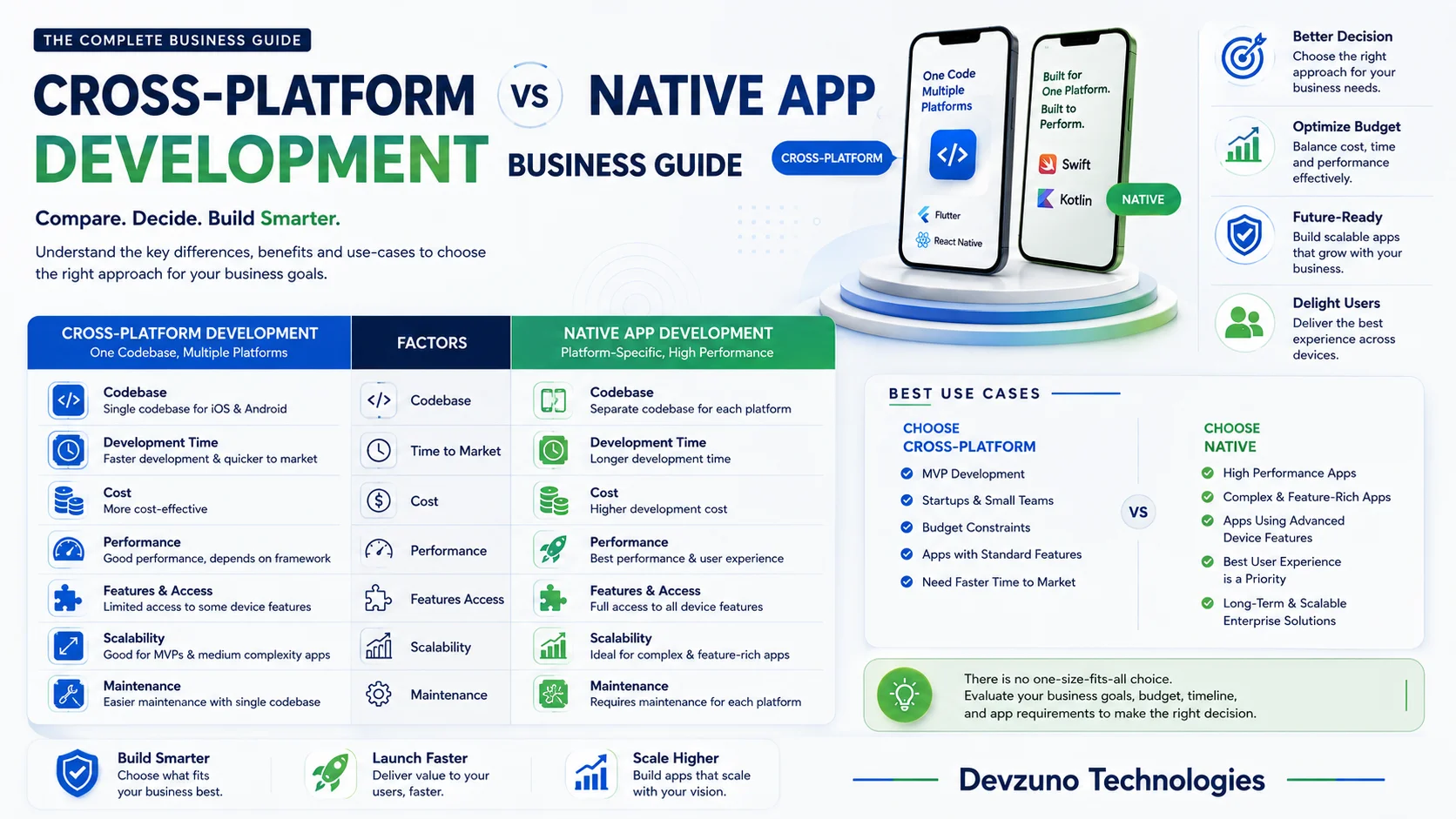
In 2026, building separate native mobile applications for iOS (Swift) and Android (Kotlin) from scratch is rarely justified for startups and growing enterprises. Maintaining two completely separate codebases doubles engineering payroll, fragments product roadmaps, and delays time-to-market.
Instead, over 80% of modern mobile applications are built using Cross-Platform Frameworks, which allow engineering teams to write a single unified codebase that compiles natively for both Apple iOS and Google Android.
The two undisputed market leaders are Google Flutter and Meta React Native.
This executive guide provides a transparent business and performance comparison between Flutter and React Native—evaluating app responsiveness, hardware integration, developer hiring availability, and development costs in both $ USD and ₹ INR (Rupees) without any code.
1. The Core Paradigm: Canvas Rendering (Flutter) vs. Native Bridge (React Native)
Direct Canvas Engine (Impeller)
Renders every pixel directly onto the screen via Google's Impeller GPU engine. Guarantees 100% identical UI look and fluid 120fps animations across all iPhone and Android models.
<div class="mt-5 space-y-2 border-t border-cyan-500/20 pt-4 text-xs text-slate-600">
  <div class="flex items-center gap-2 text-blue-600 font-medium"><span class="font-bold">✓</span> Zero UI fragmentation between iOS and older Android devices</div>
  <div class="flex items-center gap-2 text-blue-600 font-medium"><span class="font-bold">✓</span> High-performance custom charts, 3D animations & fintech UIs</div>
  <div class="flex items-center gap-2 text-emerald-600 font-bold"><span class="font-bold">✓</span> Best for: Fintech, e-commerce, on-demand apps & modern startups</div>
</div>New Architecture (Fabric & TurboModules)
Translates JavaScript/TypeScript code directly into native iOS and Android OEM platform widgets with zero legacy JavaScript bridge overhead.
<div class="mt-5 space-y-2 border-t border-blue-500/20 pt-4 text-xs text-slate-600">
  <div class="flex items-center gap-2"><span class="font-bold">✓</span> Massive code sharing if your team already has a React web application</div>
  <div class="flex items-center gap-2"><span class="font-bold">✓</span> Huge global talent pool of senior JavaScript/TypeScript developers</div>
  <div class="flex items-center gap-2 text-emerald-600 font-bold"><span class="font-bold">✓</span> Best for: Established web companies expanding to mobile apps</div>
</div>
2. Comprehensive 8-Point Business Evaluation Matrix
| Evaluation Dimension | Google Flutter (Devzuno Recommendation) | Meta React Native |
|---|---|---|
| UI Consistency | 100% Identical on all screen sizes (Pixel-perfect) | Relies on native OEM widgets (Slight OS variances) |
| Animation Performance | Fluid 60–120 FPS with Impeller GPU engine | Very good with New Architecture Fabric |
| Development Velocity | Fast (Single unified widget tree) | Fast (Strong React community libraries) |
| Web & Desktop Export | High quality (Single code for iOS, Android, Web) | Requires React Native for Web setup |
| App Startup Time | Sub-second (Direct machine code compilation) | Fast with Hermes JavaScript engine |
| Developer Ecosystem | Dart (Growing rapidly, very clean & typed) | TypeScript/JavaScript (Massive ecosystem) |
| Hardware Bluetooth/Sensors | Excellent native plugin ecosystem | Excellent native bridging modules |
| Cost Savings vs Native | 40% – 50% Cheaper than building Swift + Kotlin | 40% – 50% Cheaper than building Swift + Kotlin |
3. Mobile App Development Pricing Breakdown (USD & INR)
$14,000 – $25,000
₹11.5 Lakhs – ₹21 Lakhs
Custom UI/UX, user authentication, social logins, push notifications, and App Store + Google Play launch in 6 to 8 weeks.
$30,000 – $65,000
₹25 Lakhs – ₹55 Lakhs
Real-time GPS tracking, in-app payment gateways (Stripe/Razorpay), in-app chat, offline caching, and admin dashboard in 10 to 14 weeks.
$70,000 – $130,000+
₹58 Lakhs – ₹1.1 Crore+
Bank-grade encryption, biometric face-ID, multi-vendor escrow payments, AI recommendation engine, and compliance auditing.
4. Build Your Cross-Platform Mobile App with Devzuno
Stop overpaying for two separate iOS and Android engineering teams.
At Devzuno Technologies, our senior mobile squad builds high-performance, award-winning Flutter and React Native mobile applications delivered on time and within budget, with 100% intellectual property ownership.
👉 Get an Instant Mobile App Cost Estimate with Devzuno’s mobile solutions architects today.