
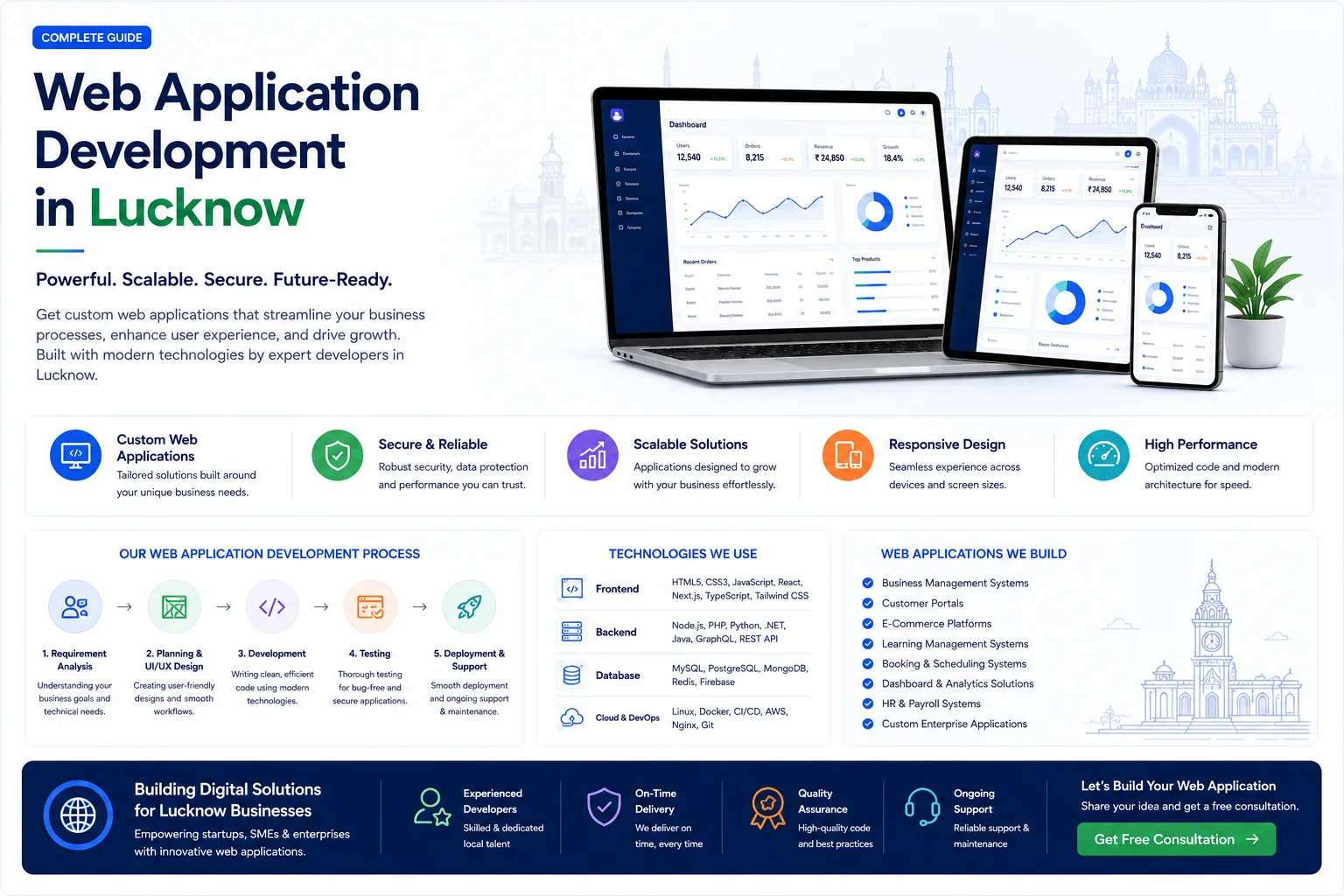
Lucknow has rapidly established itself as Uttar Pradesh’s leading technology and corporate software hub. As IT infrastructure expands across Gomti Nagar IT City, Hazratganj, Alambagh, Indira Nagar, and Mahanagar, regional enterprises and high-growth startups are shifting away from generic website templates toward custom, full-stack web applications.
Modern businesses require web portals that do far more than display static text. Today, enterprise web applications serve as mission-critical operational portals—handling real-time data sync, multi-role user dashboards, automated payment gateway checkouts, and seamless third-party API integrations.
Partnering with a leading web application development company in Lucknow like Devzuno Technologies allows organizations to engineer scalable, secure, and lightning-fast web applications designed for organic search engine dominance and exceptional user retention.
1. The Growing Web Application Landscape in Lucknow (2026)
The digital economy across Uttar Pradesh is expanding rapidly. With government initiatives promoting IT investment and local businesses digitizing their supply chains, custom web applications have become essential for operational growth:
- Enterprise Client Portals: B2B brands in Lucknow require dedicated web dashboards allowing clients to track project milestones, download invoices, and submit support tickets in real-time.
- Internal ERP & Workflow Automation: Custom administrative web tools that eliminate manual spreadsheet dependencies across inventory tracking, HR payroll, and sales CRM pipelines.
- Hyperlocal Service Web Portals: On-demand web applications serving retail, logistics, and healthcare markets across Lucknow, Kanpur, and broader North India.
- High-Speed SEO Performance: Delivering sub-second page loads to dominate Google search rankings for competitive regional keywords.
- Omnichannel Mobile Sync: Web applications engineered to share APIs seamlessly with iOS and Android mobile apps.
2. Web Application Frameworks: SSG vs. SSR vs. SPA Evaluation
Selecting the appropriate web rendering architecture directly influences page load speeds, SEO rankings, and user experience. Below is a comprehensive comparison of modern web rendering strategies:
| Architectural Metric | Static Site Generation (SSG - Astro) | Server-Side Rendering (SSR - Next.js) | Single Page Application (SPA - React/Vite) |
|---|---|---|---|
| Initial Load Speed (LCP) | Sub-0.8 Seconds (Fastest) | 1.0 – 1.8 Seconds | 2.5 – 4.5 Seconds (Slower client render) |
| Google SEO & LLM Indexing | 100/100 Perfect Indexing | Excellent Server Indexing | Weak (Requires JavaScript execution) |
| JavaScript Bundle Size | 0 KB Default (Islands Architecture) | 85 KB – 250 KB Base | 400 KB – 1.5 MB Heavy Bundle |
| Server Cost Efficiency | Extremely Cheap (Static CDN edge caching) | Moderate (Requires node server execution) | Cheap (Static file host) |
| Best Suited Use Case | Marketing Sites, Corporate Portals, Blogs | Dynamic Portals, E-Commerce, Dashboards | Gated Internal Admin Panels |
The Devzuno Hybrid Web Strategy
For client web projects in Lucknow, Devzuno implements a Hybrid Architecture: Utilizing Astro for public-facing, search-indexed marketing pages to guarantee 100/100 Google Lighthouse scores, while embedding React / Next.js modules for interactive authenticated web portals.
3. Web Architecture Patterns: Monolithic vs. Microservices vs. Serverless
Choosing the structural blueprint for your web application determines long-term maintenance costs and system reliability:
A. Monolithic Web Architecture (Best for Startups & MVPs)
A single codebase containing the frontend user interface, backend API, and database models. It allows rapid initial development velocity and easy debugging for projects in early launch phases.
B. Decoupled Microservices Architecture (Best for High-Scale Enterprise)
Frontend user interfaces (built with Astro/Next.js) are completely decoupled from backend microservices (Node.js/Go). Microservices communicate asynchronously via REST/gRPC, allowing independent auto-scaling of specific modules (e.g., separating payment handling from search indexing).
C. Serverless Architecture (AWS Lambda & Cloudflare Workers)
Backend code executes inside event-driven cloud functions that scale down to zero when idle. Eliminates idle server costs while scaling automatically during sudden traffic spikes.
4. Progressive Web Applications (PWA) vs. Native Web Portals
For businesses looking to offer an app-like mobile experience without requiring users to download an application from the Play Store or App Store, Progressive Web Applications (PWA) provide a compelling solution:
- Installable on Mobile Homescreens: Users can add your web application directly to their Android or iPhone homescreen with a single tap.
- Offline Capabilities via Service Workers: Caching core assets and API responses locally so users can browse catalogs or view tickets even when disconnected from the internet.
- Web Push Notifications: Re-engaging users with targeted push notifications sent directly to their mobile or desktop browser via Firebase Cloud Messaging.
5. Key Architectural Modules of an Enterprise Web Application
A production-ready web application built by Devzuno incorporates seven core technical modules:
┌───────────────────────────────────────────────────────────────────────────┐
│                    GLOBAL CLOUDFLARE WAF & EDGE CDN                       │
└─────────────────────────────────────┬─────────────────────────────────────┘
                                      │
                                      ▼
┌───────────────────────────────────────────────────────────────────────────┐
│              FRONTEND LAYER (Astro / Next.js / React / TypeScript)        │
└─────────────────────────────────────┬─────────────────────────────────────┘
                                      │
                                      ▼
┌───────────────────────────────────────────────────────────────────────────┐
│           BACKEND MICROSERVICES API (Node.js / Go / Python FastAPI)        │
└───────────────────────────┬───────────────────┬───────────────────────────┘
                            │                   │
                            ▼                   ▼
┌──────────────────────────────────┐  ┌──────────────────────────────────┐
│   DATABASE LAYER (PostgreSQL)    │  │    REDIS CACHE & QUEUE SYSTEM    │
│  (ACID Relational & JSONB Data)  │  │  (Session Cache & BullMQ Queue)  │
└──────────────────────────────────┘  └──────────────────────────────────┘
A. Responsive UI/UX Design System
Tailored interface layouts built using modern CSS custom properties and Flexbox/Grid architectures that adapt fluidly across mobile smartphones, tablets, laptops, and 4K desktop displays.
B. High-Concurrency API Layer & CORS Management
Lightweight RESTful and GraphQL APIs built with Node.js (TypeScript) or Go (Golang) capable of processing thousands of database queries per second with sub-50ms latency. Strict Cross-Origin Resource Sharing (CORS) policies ensure APIs only accept calls from authorized domain origins.
C. Domestic & Global Payment Integration
Seamless checkout integrations with Razorpay, PhonePe, Paytm, Stripe, and Cashfree supporting instant UPI, credit/debit cards, NetBanking, and automated recurring billing.
D. Real-Time Data Synchronization (WebSockets vs. SSE)
We select the appropriate real-time protocol based on project needs:
- WebSockets (Socket.io): Full-duplex, bidirectional communication channels for live chat and interactive multi-user dashboards.
- Server-Sent Events (SSE): One-way lightweight HTTP streaming for real-time stock ticks, order status notifications, and live AI text streaming.
6. Database Indexing & High-Volume Query Optimization
Slow database queries are the primary cause of web application downtime during peak traffic hours. Devzuno implements rigorous PostgreSQL optimization techniques:
- Composite & B-Tree Indexing: Indexing frequently queried database columns (e.g.,
tenant_id,created_at,status) to eliminate full table scans. - JSONB Indexing (GIN Indexes): Indexing dynamic JSON fields within PostgreSQL to allow sub-millisecond document searching without migrating to NoSQL databases.
- Database Connection Pooling (PgBouncer): Reusing active SQL database connections to prevent RAM exhaustion during sudden user traffic spikes.
7. CDN Edge Cache Revalidation & Server-Side Caching
To serve dynamic content at sub-second speeds, Devzuno implements intelligent caching layers:
- Stale-While-Revalidate Caching: Serving cached HTML pages instantly from Cloudflare edge nodes while asynchronously fetching updated data in the background.
- Redis Fragment Caching: Caching heavy database query results (such as complex product search aggregations or user permission trees) in Redis to reduce database read load by up to 80%.
8. Web Accessibility (WCAG 2.1 AA) & Vernacular Localization
Building web applications for Uttar Pradesh requires serving diverse user demographics across cities and rural areas:
- WCAG 2.1 AA Accessibility: Semantic HTML5 tags, proper ARIA attributes, and high-contrast color ratios ensuring screen reader compatibility for visually impaired users.
- Dynamic Hindi & English Localization: Allowing users to toggle between English and Hindi interfaces seamlessly with state persistence.
9. Web Performance Tuning & Core Web Vitals Optimization
Slow web applications alienate users and suffer organic Google ranking penalties. Devzuno implements rigorous performance tuning across every web project:
- Image & Asset Optimization: Converting legacy PNG/JPG images to next-gen
.webpor.avifformats with explicitwidthandheightattributes to prevent Cumulative Layout Shift (CLS < 0.1). - Font Subsetting & Preloading: Self-hosting WOFF2 web fonts with
font-display: swapto eliminate render-blocking typography delays. - Code Splitting & Dynamic Imports: Splitting heavy JavaScript bundles so users only download the code required for their immediate viewport.
10. Data Residency & Regional Compliance in India
For enterprise software dealing with Indian user data, compliance with the Digital Personal Data Protection (DPDP) Act 2023 is mandatory:
- Local Cloud Hosting (AWS Mumbai Region): Hosting databases and application workloads within AWS Mumbai (
ap-south-1) cloud data centers to guarantee domestic data residency. - Consent Management Workflows: Building granular user consent interfaces for personal data processing and automated data deletion workflows upon request.
11. Industry-Specific Web Solutions for Lucknow Businesses
Devzuno crafts tailored web applications customized to regional business needs across Uttar Pradesh:
🏥 Healthcare & Hospital Web Portals
- Patient appointment booking with doctor availability schedules.
- E-Prescription downloads and lab test result portals.
- Integration with Ayushman Bharat Digital Mission (ABDM) ABHA ID stack.
🏫 Educational Institutions & Coaching Portals
- Online student registration and fee payment processing.
- Learning Management System (LMS) with video lecture streaming and quiz modules.
- Parent-teacher communication channels and attendance tracking.
🛍️ Retail & E-Commerce Web Platforms
- Custom multi-vendor marketplaces with sub-second product catalog search.
- Inventory management integration with local warehouse databases.
- Instant WhatsApp order confirmation alerts and delivery tracking.
🏢 Real Estate & Property Management Portals
- Interactive 3D virtual tour embeds and map location filtering.
- Lead capture CRM integration with automated agent assignment.
- Builder project documentation and payment schedule tracking.
12. Real-World Case Studies in Lucknow & UP
Case Study 1: Healthcare Clinic Network in Gomti Nagar
A multi-specialty clinic network operating in Gomti Nagar required a custom web portal to replace manual phone appointments and paper prescriptions.
The Devzuno Solution: Devzuno engineered a secure, mobile-responsive web portal integrated with WhatsApp OTP authentication, online UPI fee payments, and digital lab report delivery.
Results: Patient online appointment bookings surged by 210%, appointment no-shows dropped by 65%, and clinic administrative overhead was reduced by ₹4.5 Lakhs annually.
13. Security, Session Management & OWASP Web Safeguards
Web application security is paramount. Devzuno enforces end-to-end security protocols compliant with OWASP Top 10 Web Vulnerabilities:
- SQL Injection Prevention: Utilizing parameterized SQL queries and typed ORMs (Prisma, Drizzle) to completely eliminate SQL injection vectors.
- Cross-Site Scripting (XSS) Mitigation: Strict input sanitization and Content Security Policies (CSP) preventing malicious script execution.
- Cross-Site Request Forgery (CSRF) Protection: Anti-CSRF token verification on all state-changing HTTP requests.
- Session Revocation & Redis Token Blacklisting: Storing JWT token revocation IDs (jti) in Redis. If an admin disables a compromised account, the user session is revoked globally within milliseconds.
- Rate Limiting & DDoS Safeguards: Implementing Redis-based sliding window rate limiters (e.g., max 100 API requests per minute per IP address) to prevent brute-force attacks.
- HTTPS Encryption & HSTS: Enforcing TLS 1.3 encryption across all web traffic with HTTP Strict Transport Security headers.
- Role-Based Access Control (RBAC): Granular user permission enforcement ensuring users can only access data belonging to their authorized role.
14. Continuous Deployment Pipeline (CI/CD) with AWS & GitHub Actions
Deploying web application updates to production without downtime requires an automated CI/CD pipeline:
[Git Commit to Main] ➔ [GitHub Actions CI Runner] ➔ [TypeScript & Vitest Audit] ➔ [Build Docker Image] ➔ [Deploy to AWS ECS Cluster]- Automated Regression Testing: Running Vitest unit tests and Playwright E2E tests before code merges.
- Zero-Downtime Rolling Deployments: Spinning up new AWS ECS container tasks and verifying health checks before draining traffic from old container instances.
15. The 6-Stage Web Engineering Lifecycle at Devzuno
At Devzuno, we follow a transparent Agile web development process:
Stage 1: Requirement Gathering & SRS Specs
  └── Stage 2: UI/UX Wireframing & Figma Prototypes
        └── Stage 3: Full-Stack Web Development Sprints
              └── Stage 4: Automated QA & Security Vulnerability Audit
                    └── Stage 5: Cloud Deployment & Domain Setup
                          └── Stage 6: Ongoing Maintenance & SLA Support
Stage 1: SRS & Wireframing
We document business goals, define technical requirements, and create interactive Figma prototypes for client approval before writing code.
Stage 2: Full-Stack Development
Development proceeds in bi-weekly Agile sprints. Clients receive staging URLs to review functional features as they are built.
Stage 3: Quality Assurance & Launch
Our QA engineers perform cross-browser compatibility testing, mobile responsiveness audits, load testing, and security scans prior to production deployment.
16. Cost & Timeline Breakdown for Web App Development in Lucknow
The cost of custom web application development depends on scope, user roles, API complexity, and backend requirements:
- Basic Web App / Business MVP: ₹1.2 Lakh – ₹3.0 Lakh (3 to 5 Weeks timeline)
- Mid-Tier Custom SaaS / Web Portal: ₹3.5 Lakh – ₹6.5 Lakh (6 to 10 Weeks timeline)
- Enterprise Multi-Tenant Web Platform: ₹7.0 Lakh – ₹14+ Lakh (10 to 16 Weeks timeline)
17. Why Devzuno Technologies is Lucknow’s Top Web Engineering Partner
Devzuno Technologies is a premier web application development company in Lucknow committed to delivering high-impact software solutions:
- Modern Tech Stack Expertise: Masters in Astro, Next.js, React, Node.js, Go, Python, PostgreSQL, and AWS Cloud.
- Search Engine Dominance: Engineered with technical SEO best practices for top Google rankings.
- 100% Code & IP Ownership: Complete transfer of source code repositories, deployment scripts, and intellectual property rights.
- Transparent SLA Support: Continuous post-launch monitoring, security patches, and cloud server maintenance.
18. Frequently Asked Questions (FAQs)
Q1. What is the difference between a static website and a custom web application?
A static website displays fixed information to visitors (like a digital brochure). A custom web application is an interactive software platform with user logins, database interactions, custom dashboards, payment checkouts, and real-time workflows.
Q2. How long does it take to develop a custom web application in Lucknow?
A basic web application or MVP takes 4 to 6 weeks, while a complex enterprise web portal or SaaS platform takes 8 to 14 weeks to build and launch.
Q3. Will my web application be mobile-friendly?
Yes! Every web application engineered by Devzuno is built using Mobile-First Responsive Design, ensuring seamless performance on smartphones, tablets, and desktop displays.
Q4. Who owns the source code of the web application?
You own 100% of the source code, database schemas, design assets, and IP rights. Upon project completion, we hand over full access to all GitHub repositories and cloud infrastructure.
Q5. How do we get started with Devzuno Technologies?
Contact the web engineering team at Devzuno Technologies to schedule an architectural discovery call. We will review your project needs and provide a detailed SRS spec, timeline, and fixed-price quote.
Ready to Build Your Custom Web Application?
Transform your business operations with a high-speed, secure custom web application. Contact Devzuno Technologies today to consult with our lead web architects.