In 2026, corporate decision-makers, CTOs, and founders face a pivotal architectural dilemma: Should you buy commercial off-the-shelf (COTS) SaaS software or invest in custom enterprise software engineering?
While subscription-based SaaS tools promise rapid setup, fast-growing companies often discover hidden subscription traps, rigid workflow constraints, per-user seat penalties, and strict data lock-in. Conversely, custom software engineered by a strategic software development partner like Devzuno Technologies delivers full IP ownership, infinite scalability, and bespoke workflow integration.
This guide provides a comprehensive cost, security, scalability, and long-term Return on Investment (ROI) evaluation framework to help executive leaders make an informed decision.
1. Defining the Core Software Architectures
Before evaluating financial models, it is essential to understand the technical definitions:
Off-the-Shelf Commercial SaaS (COTS)
Off-the-shelf software refers to pre-built, standardized software hosted on a vendor’s multi-tenant cloud (e.g., Salesforce, HubSpot, SAP, Workday). You rent access to the software on a recurring monthly or annual subscription, typically priced per active user seat.
Custom Enterprise Software Engineering
Custom enterprise software is bespoke code engineered specifically to fit your business workflows, database schemas, compliance guidelines, and operational procedures. Your organization owns 100% of the source code, intellectual property, and deployment infrastructure.
2. Comprehensive 10-Point Comparison Framework
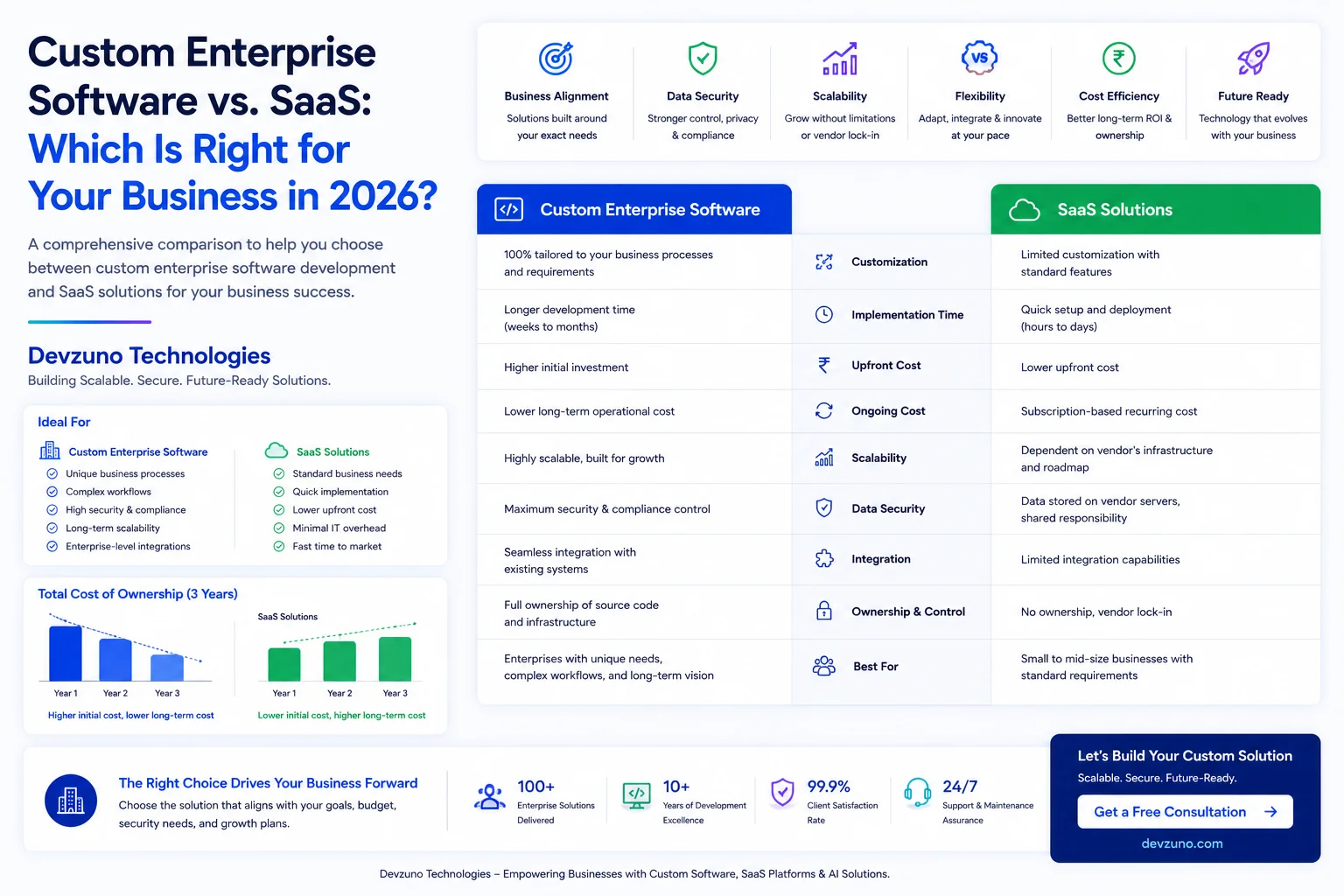
Below is an exhaustive technical and business comparison between Custom Enterprise Software and Off-the-Shelf SaaS:
| Evaluation Dimension | Off-the-Shelf SaaS (Commercial) | Custom Enterprise Software (Devzuno) |
|---|---|---|
| Initial Upfront Cost | Low upfront setup fee | Moderate to high initial engineering capital |
| Long-Term Financial Model | Perpetual recurring seat fees (Increases with scale) | One-time development asset (Predictable maintenance) |
| Source Code & IP Ownership | 0% (Vendor owns all IP & codebase) | 100% Full Intellectual Property Ownership |
| Workflow Flexibility | Rigid (Must adapt your business processes to the tool) | 100% Tailored (Software adapts to your business) |
| Third-Party API Integration | Restricted to vendor-approved API connectors | Unlimited custom REST, GraphQL, & Webhook connectors |
| Data Privacy & Governance | Multi-tenant shared cloud (Vendor holds data) | Dedicated private cloud / On-premise VPC control |
| Scalability Bottlenecks | Vendor enforced API rate limits & storage caps | Unlimited database & compute scaling on AWS/Azure |
| Custom Feature Requests | Dependent on vendor roadmap (Low influence) | Total control over feature prioritization |
| Competitive Advantage | Zero (Competitors use the exact same tool) | High (Bespoke internal automation creates moat) |
| Vendor Lock-In Risk | Extreme (Data migration is costly and painful) | Zero (Full source code portability) |
3. Financial Analysis: TCO & ROI Over 5 Years
Many executives fall into the “Low Initial Cost” trap of SaaS subscriptions. To understand the true financial impact, we must analyze the Total Cost of Ownership (TCO) over a 5-year timeline.
Scenario: A Growing 150-Employee Enterprise
Imagine a company with 150 employees requiring an internal Operations & Workflow Management System.
       5-YEAR TOTAL COST OF OWNERSHIP (TCO) COMPARISON

Cost (INR)
  ▲
  │                                    / [Off-the-Shelf SaaS]
  │                                   /  (Perpetual Seat Fees + Price Hikes)
  │                                  /
  │                                 /
  │    ┌───────────────────────────/──── [Custom Software Asset]
  │    │                          /      (Fixed Engineering + Low Maintenance)
  │    │                         /
  │    │                        /
  └────┴───────────────────────┴─────────────────────────────────► Time (Years)
     Year 1                  Year 3                       Year 5
Option A: Off-the-Shelf SaaS Subscription
- Monthly Fee per Seat: $50 (~₹4,150) per user/month.
- 150 Users Monthly Cost: ₹6,22,500 per month.
- Annual Subscription Cost: ₹74.7 Lakhs per year.
- Vendor Price Increases (Avg 10% annual hike): Year 1-5 total = ₹4.55 Crores.
- Additional Costs: Mandatory tier upgrades for API access + data export fees.
Option B: Custom Software Engineering with Devzuno
- Initial Development Cost: ₹15.0 Lakhs (One-time capital expenditure).
- Annual Cloud Hosting & Maintenance (SLA): ₹2.4 Lakhs per year.
- 5-Year Maintenance Cost: ₹12.0 Lakhs.
- 5-Year Total Cost of Ownership: ₹27.0 Lakhs.
💡 The Financial Verdict:
By Year 3, the cumulative subscription cost of off-the-shelf SaaS exceeds the total cost of custom software development. Over 5 years, Custom Software delivers a 94% cost reduction, saving over ₹4.2 Crores while building a valuable corporate digital asset.
4. Hidden SaaS Fees: API Limits, Storage Penalties & Feature Gating
In addition to base seat pricing, SaaS vendors utilize aggressive monetization strategies that drive up monthly invoices:
- API Call Tier Penalties: Most commercial SaaS platforms impose daily API request limits (e.g., 10,000 calls/day). When your enterprise integrates automated tools or syncs large datasets, you are forced to upgrade to “Enterprise Tiers” costing 3x to 5x more per seat.
- Storage Surcharges: Attachment file storage (PDF invoices, images, contracts) inside SaaS platforms is often capped at 2GB to 5GB per user. Additional storage is billed at inflated rates compared to raw cloud storage (e.g., AWS S3 costs only $0.023/GB).
- Feature Gating: Essential enterprise features such as Single Sign-On (SSO / SAML), audit logs, and custom roles are routinely locked behind top-tier Enterprise pricing packages.
5. Impact on Company Valuation & Intellectual Property
For startups, mid-market companies, and enterprise organizations seeking venture capital, private equity, or strategic acquisition, software ownership directly impacts corporate valuation.
A. SaaS Subscriptions as Operational Expenses (OpEx)
Subscribing to third-party SaaS applications generates ongoing Operational Expenditure (OpEx) without accumulating tangible assets on your balance sheet. Investors recognize that your operational technology is rented and can be cloned by any competitor using the exact same SaaS tools.
B. Proprietary Codebase as Capital Assets (CapEx)
Investing in custom software allows companies to capitalize development expenses as Intellectual Property (IP) on their balance sheet. Owning proprietary algorithms, custom internal CRM tools, or specialized automation backends increases corporate valuation multiples during M&A (Mergers & Acquisitions) or investment fundraising rounds.
6. Employee Productivity & “SaaS Fatigue”
Modern enterprises often suffer from “SaaS Bloat”—the accumulation of 15 to 25 disconnected subscription tools across sales, marketing, operations, HR, and finance.
The Hidden Cost of Context Switching:
- Fragmented User Experience: Employees spend an average of 45 minutes daily switching between disparate SaaS logins, navigating different UIs, and resolving password resets.
- Data Silos & Duplicate Entry: When tools fail to sync automatically, staff are forced to manually copy customer records between accounting software, CRMs, and project trackers, introducing human data errors.
- Unified Custom Portals: Devzuno consolidates these fragmented tools into a single, cohesive enterprise portal. Employees interact with a unified dashboard tailored precisely to their daily operational responsibilities.
7. Scalability, Customization & Workflow Bottlenecks
Off-the-shelf SaaS applications are engineered for the average business. However, rapidly growing enterprises operate on unique workflows that give them a competitive advantage.
A. The “Workflow Mismatch” Problem
When using standardized SaaS, companies are forced to alter their internal operational processes to fit the software’s hardcoded UX rules. Employees spend hours manually copying data between disconnected SaaS tools.
B. Custom Automation as a Competitive Moat
Custom software built by Devzuno mirrors your exact business processes. By engineering automated triggers, custom calculation logic, and direct database pipelines, employee productivity increases by 40-60%.
8. Security, Data Sovereignty & Vendor Lock-In Risks
Data sovereignty is no longer optional. Regulatory mandates (such as DPDP Act in India, GDPR in Europe, and HIPAA in Healthcare) require strict data residency and audit control.
A. Data Lock-In Risks in Commercial SaaS
When storing proprietary customer records, financial ledgers, or product designs inside a commercial SaaS ecosystem, your business is at the mercy of the vendor:
- Unannounced Pricing Hikes: SaaS vendors routinely increase monthly subscription fees with short notice.
- Data Migration Roadblocks: Exporting historical data from SaaS platforms is often restricted to simplified CSV files, stripping out complex data relationships.
- Service Discontinuation: If a SaaS startup goes out of business or pivots, your access to critical operational data can disappear overnight.
B. Enterprise Security in Custom Software
Devzuno engineers custom applications with private cloud hosting inside your dedicated AWS, Azure, or Google Cloud Virtual Private Cloud (VPC):
- Data Isolation: Complete single-tenant database isolation.
- End-to-End Encryption: AES-256 database encryption at rest and TLS 1.3 encryption in transit.
- Custom RBAC (Role-Based Access Control): Granular permission sets preventing unauthorized internal data access.
- Regulatory Compliance: Engineered to satisfy ISO 27001, SOC 2 Type II, and Indian DPDP 2023 compliance standards.
9. Hybrid Architecture: The Third Alternative
In certain enterprise scenarios, the optimal strategy is a Hybrid Software Architecture.
Instead of choosing 100% Custom or 100% SaaS, companies combine best-in-class specialized SaaS APIs with a custom enterprise core:
┌───────────────────────────────────────────────────────────────────────────┐
│                    CUSTOM ENTERPRISE CORE SYSTEM                          │
│         (Bespoke Workflows, Database & User Interface by Devzuno)         │
└─────────────────────────────────────┬─────────────────────────────────────┘
                                      │
       ┌──────────────────────────────┼──────────────────────────────┐
       ▼                              ▼                              ▼
┌──────────────┐               ┌──────────────┐               ┌──────────────┐
│ Payment API  │               │ Messaging API│               │ AI Analytics │
│ (Razorpay /  │               │ (Twilio /    │               │ (OpenAI /    │
│   Stripe)    │               │  WhatsApp)   │               │ AWS Bedrock) │
└──────────────┘               └──────────────┘               └──────────────┘
This hybrid approach allows you to retain total IP ownership over your core operational logic while delegating specialized functions (e.g., payment processing or SMS dispatch) to established infrastructure APIs.
10. Strategic Migration Roadmap: Transitioning from SaaS to Custom
Transitioning from a messy network of third-party SaaS subscriptions to a custom enterprise platform requires a risk-mitigated phased migration strategy:
Phase 1: Workflow Audit & Feature Mapping (Weeks 1-2)
  └── Phase 2: Schema Design & API Integration (Weeks 3-5)
        └── Phase 3: Custom Core Platform Development (Weeks 6-10)
              └── Phase 4: Data Extraction & ETL Migration (Weeks 11-12)
└── Phase 5: Parallel Testing & Final Cutover (Weeks 13-14)- Extraction & ETL Data Pipelines: Devzuno builds automated extraction scripts (ETL) to clean and migrate legacy SaaS data into your new PostgreSQL/MongoDB database without data loss.
- Parallel Testing Run: Operating the new custom software alongside legacy SaaS for 2 weeks to verify mathematical calculations, billing logic, and audit trails before cancelling SaaS subscriptions.
11. Strategic Decision Matrix: When to Buy vs. When to Build
Use this decision matrix to evaluate your next software initiative:
✅ BUY Off-the-Shelf SaaS When:
- Generic Commodity Functionality: The software performs standard commodity tasks (e.g., basic email hosting like Google Workspace or team chat like Slack).
- Immediate Needs (Day 1 Utility): You need a temporary solution running within 24 hours.
- Zero In-House Technical Needs: The business has fewer than 10 employees and does not require complex data workflows.
🏗️ BUILD Custom Enterprise Software When:
- Core Business Process: The software directly manages core revenue-generating operations or customer fulfillment.
- Rapidly Growing Team (>20 Employees): Recurring SaaS seat licenses are becoming financially unsustainable.
- Strict Compliance & Security Requirements: You handle sensitive medical, financial, or proprietary customer data requiring VPC isolation.
- Unique Competitive Workflow: Your internal workflows are proprietary and give you a market advantage over competitors.
- Seeking Long-Term Asset Creation: You want to increase enterprise valuation by owning proprietary digital software assets.
12. Devzuno’s Custom Software Engineering Process
At Devzuno Technologies, we reduce engineering risk by executing custom software projects using a structured, transparent lifecycle:
[1. SRS & Business Audit] ➔ [2. System Architecture Design] ➔ [3. Agile Development Sprints] ➔ [4. Automated QA & Security Audit] ➔ [5. Deployment & Full IP Handover]1. SRS & Business Audit
We audit your existing manual workflows, spreadsheet dependencies, and operational bottlenecks to author a clear Software Requirements Specification (SRS).
2. Modern Tech Stack Selection
We utilize battle-tested open-source frameworks to avoid proprietary licensing fees:
- Frontend: React, Next.js, Astro, or Flutter for ultra-fast, responsive user interfaces.
- Backend: Node.js (TypeScript), Go (Golang), or Python (FastAPI).
- Databases: PostgreSQL, MongoDB, and Redis caching layers.
- Infrastructure: Docker containers deployed on AWS ECS / EKS or Kubernetes.
3. Agile Sprints & Transparent Delivery
Developments proceed in bi-weekly sprints with live staging links, allowing your team to test functional features continuously.
4. 100% Code & IP Handover
Upon project completion, we transfer all GitHub code repositories, deployment scripts, database schemas, and intellectual property titles directly to your company.
13. Real-World Case Studies & ROI Success Stories
Case Study 1: Regional Logistics Brand Saves ₹38 Lakhs Annually
A mid-sized logistics enterprise operating across North India was paying ₹42 Lakhs annually for a commercial fleet tracking SaaS. The platform enforced strict limits on historical route tracking and charged extra for custom API exports.
The Devzuno Solution: Devzuno engineered a custom web and mobile fleet management system featuring live GPS WebSocket tracking, automated dispatch routing, and custom WhatsApp invoice generation.
Results: Total one-time engineering cost was ₹12 Lakhs. Annual maintenance dropped to ₹2.2 Lakhs. The company achieved full ROI payback in 4 months and saved ₹38 Lakhs per year in subscription fees.
14. Frequently Asked Questions (FAQs)
Q1. Isn’t building custom software much more expensive than renting SaaS?
In the short term (Months 1-6), off-the-shelf SaaS appears cheaper because setup fees are low. However, as your team grows, recurring seat licenses, add-on feature tiers, and API usage fees accumulate rapidly. By Year 2 or 3, custom software is almost always significantly cheaper than recurring SaaS subscriptions.
Q2. How long does it take to build a custom enterprise software application?
A focused enterprise MVP or core business system typically takes 8 to 12 weeks to engineer and deploy. Complex multi-department enterprise platforms take 12 to 20 weeks.
Q3. Who maintains the custom software after it is deployed?
Devzuno provides dedicated post-launch support and maintenance SLAs. We handle server infrastructure monitoring, OS updates, security patches, database backups, and ongoing feature enhancements.
Q4. Can custom software integrate with our existing legacy databases?
Yes. Devzuno specializes in engineering custom middleware and RESTful APIs that connect new custom software seamlessly with legacy databases, ERP systems, and third-party tools.
Q5. What happens if our business processes change in the future?
Because you own 100% of the source code, custom software can be modified, expanded, or reconfigured at any time without asking permission from a SaaS vendor or waiting for their product updates.
Q6. How do we start a custom software project with Devzuno?
Simply reach out to the engineering team at Devzuno Technologies to schedule an architectural consultation. We will analyze your operational requirements and provide a detailed SRS, fixed-price proposal, and step-by-step roadmap.
Ready to Build Your Proprietary Software Asset?
Stop renting rigid SaaS tools and build a custom enterprise platform that scales with your business. Contact Devzuno Technologies today to consult with our principal software architects.