
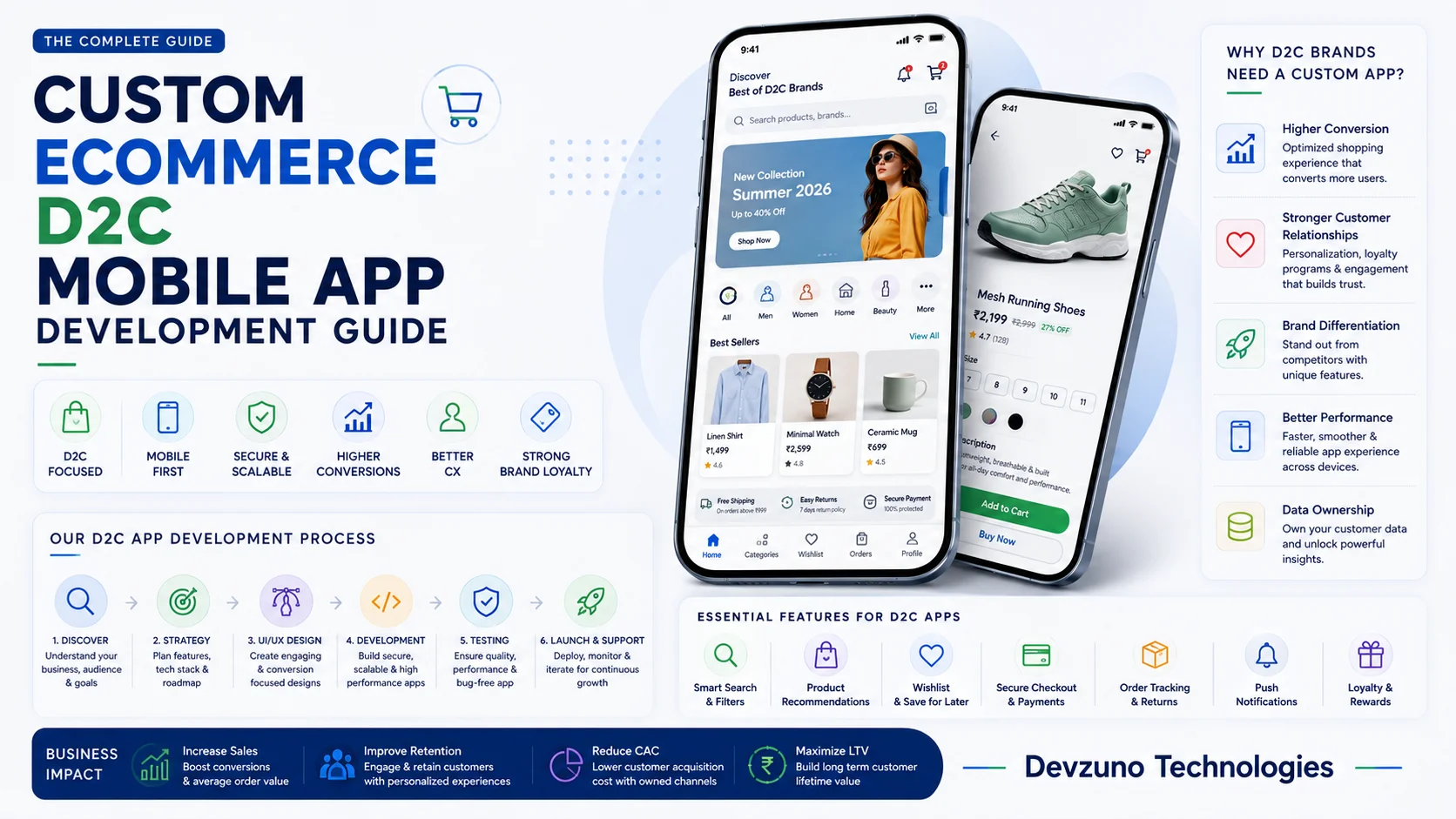
In 2026, India’s Direct-to-Consumer (D2C) and retail e-commerce market is experiencing unprecedented growth. As customer acquisition costs (CAC) rise across digital ad platforms, successful D2C brands and retail enterprises are shifting their focus from relying solely on third-party marketplaces (like Amazon or Flipkart) toward building custom, high-converting mobile applications.
A custom mobile app provides a dedicated brand channel that resides directly on a customer’s smartphone home screen. According to e-commerce industry benchmarks, mobile apps convert browsers into buyers at a rate 3.5x higher than mobile websites, while driving a 45% increase in Customer Lifetime Value (LTV).
However, building a scalable e-commerce mobile app requires making informed decisions regarding technology stack, payment gateway integration, inventory synchronization, and budget allocation.
In this comprehensive guide, we compare custom mobile apps against off-the-shelf SaaS platforms (like Shopify or WooCommerce), provide an itemized cost breakdown in Indian Rupees (₹) and USD ($), examine modern microservices architecture, explore ERP/inventory integrations, and outline proven strategies to maximize your app’s return on investment.
1. Custom Mobile App vs. Off-the-Shelf SaaS (Shopify / WooCommerce)
When launching or scaling an online store, many business owners begin with template-based SaaS platforms. However, as monthly Gross Merchandise Value (GMV) scales past ₹5 Lakhs, the technical limitations and recurring fees of generic platforms become apparent.
Below is a detailed comparison between template SaaS platforms and custom Flutter mobile app development:
| Metric / Feature | Template SaaS (Shopify / WooCommerce Plugin Apps) | Custom Flutter Mobile App (Devzuno Architecture) |
|---|---|---|
| Upfront Build Cost | Low initial template cost (₹20,000 – ₹50,000) | ₹1.8 Lakhs – ₹8 Lakhs (One-time milestone build) |
| Recurring Platform Fees | Monthly subscription + 1% – 2% transaction commission | 0% Platform Fees (100% full revenue retention) |
| App Performance & LCP | Slower Web-View rendering (2.5s – 4.5s load times) | Sub-Second Load Times (60-120 FPS Native Speed) |
| Checkout Conversion Rate | Standard multi-step checkout (1.8% – 2.2% avg) | Optimized 1-Click UPI Checkout (3.8% – 5.2% avg) |
| Custom UI/UX & Branding | Restricted to rigid template layouts | 100% Custom Pixel-Perfect UI Control |
| Source Code & Data Ownership | Locked into proprietary vendor ecosystem | 100% Full Source Code & Database Ownership |
Why Scaling D2C Brands Transition to Custom Mobile Apps
- Elimination of Commission Fees: SaaS platforms and third-party app plugins charge recurring monthly fees plus commission percentages on every sale. Over 2 to 3 years, these fees far exceed the one-time cost of building a custom mobile app.
- Instant Native Performance: Custom Flutter mobile applications compile directly to native machine code, eliminating the lag associated with web-view wrappers.
- Direct Customer Communication: Unrestricted access to send personalized push notifications directly to user devices without paying per-message charges.
2. Core Must-Have Features for a Modern D2C E-Commerce App
To compete effectively in 2026, your mobile e-commerce application must deliver a frictionless shopping experience. Below are the essential feature modules required for high conversion rates:
1. 1-Click Mobile OTP Authentication & Social Login
Replace friction-heavy password forms with instant phone number OTP verification via Indian SMS gateways (MSG91, Twilio) and Google/Apple 1-click authentication.
2. High-Speed Visual Product Catalog & Smart Search
- Instant Filtering: Filter products instantaneously by category, price, size, color, and availability.
- Full-Text Search Engine: Integrate fast search auto-suggestions powered by Typesense or Redis search engines.
- High-Resolution Media Gallery: Support WebP/AVIF image zoom galleries and short product video previews.
3. Native Indian Payment Gateway Integration
Provide seamless checkout options tailored for Indian shoppers:
- Instant UPI Auto-Read: One-tap payment via PhonePe, Google Pay, Paytm, and BHIM UPI.
- Credit / Debit Cards & NetBanking: PCI-DSS compliant checkout via Razorpay, Cashfree, or Stripe.
- Cash on Delivery (COD) Verification: Automated COD OTP verification to reduce Fake Order Returns (RTO - Return to Origin).
4. Automated Abandoned Cart Push Notifications
Over 70% of online shopping carts are abandoned before payment. Implement automated push notification sequences triggered 1 hour and 24 hours after cart abandonment, offering limited-time discount incentives to recover lost sales.
5. Real-Time Order Tracking & WhatsApp Notifications
Keep customers informed with live delivery stage progress (Order Placed -> Packed -> Dispatched -> Out for Delivery) paired with automated WhatsApp status updates via official WhatsApp Business APIs.
6. Personalization & AI Recommendation Engine
Display dynamically recommended “Frequently Bought Together” items and personalized product feeds based on customer browsing history and previous purchase patterns.
7. Customer Loyalty, Rewards & Referral System
Incentivize repeat purchases by embedding a wallet-style reward point system. Customers earn redeemable store points on every purchase and receive referral discounts when sharing the app with friends.
3. Technical Microservices Architecture for Scalable E-Commerce
Building an e-commerce platform capable of handling flash sales and high concurrent traffic requires a modern microservices architecture:
[Flutter iOS & Android Mobile App]
                 │
                 ▼ (HTTPS / REST & GraphQL APIs)
  [API Gateway & Rate Limiter]
                 │
  ┌──────────────┼──────────────┬──────────────┐
  ▼              ▼              ▼              ▼
[Auth Service] [Catalog Service] [Order Engine] [Payment Gateway]
  │              │              │              │
  └──────────────┴──────┬───────┴──────────────┘
                        ▼
       [PostgreSQL DB] + [Redis Cache] + [Typesense Search]
Architectural Layer Breakdown
- Mobile Frontend Layer: Flutter (Dart) provides a single unified codebase that delivers identical 60-120 FPS performance on both iOS and Android.
- API Gateway & Microservices: Node.js or Go handles API routing, rate limiting, and business logic validation.
- Database & Caching Engine: PostgreSQL serves as the primary relational store for order data, while Redis caches active user shopping carts and hot catalog items in RAM for microsecond response times.
- Warehouse & ERP Sync: Real-time bi-directional API sync connecting your mobile app with inventory management software (Unicommerce, Increff, or custom ERP systems).
4. Headless Commerce vs. Fully Custom Microservices
When architecting a custom e-commerce mobile application, D2C brands can choose between two modern technical approaches:
A. Headless Commerce Architecture (Shopify Storefront API + Flutter App)
- How It Works: Your existing web store remains on Shopify for admin management, while the mobile app frontend is built as a custom Flutter application using Shopify’s GraphQL Storefront API.
- Best For: Brands already established on Shopify who want a high-speed custom mobile app without migrating their web catalog or order history.
- Cost: ₹1.8 Lakhs – ₹4 Lakhs.
B. Fully Custom Microservices Architecture (Node.js/Go + PostgreSQL + Flutter)
- How It Works: The entire platform—database, APIs, mobile apps, and admin panel—is custom-built from scratch.
- Best For: Fast-growing D2C brands and multi-vendor marketplaces requiring zero platform commission fees, custom multi-warehouse logic, and proprietary AI engines.
- Cost: ₹3.5 Lakhs – ₹15 Lakhs+.
5. Cost Breakdown for Custom E-Commerce & D2C Apps in India (2026)
Custom e-commerce app development costs vary depending on whether you need a streamlined brand store app or a multi-vendor marketplace platform. Below is an itemized pricing breakdown for Indian businesses in 2026:
| E-Commerce App Tier | Scope & Key Capabilities | Estimated Cost (INR - ₹) | Equivalent USD ($) | Typical Timeline |
|---|---|---|---|---|
| Starter D2C Store App | Product Catalog, Shopping Cart, Razorpay/UPI Payment, OTP Login, Push Notifications | ₹1.8 Lakhs – ₹3.5 Lakhs | $2,200 – $4,200 | 5 – 8 Weeks |
| Full Custom D2C Brand App | Advanced Filters, AI Recommendations, Loyalty Wallet, Live Tracking, Admin Web Dashboard | ₹3.5 Lakhs – ₹8 Lakhs | $4,200 – $9,500 | 8 – 14 Weeks |
| Multi-Vendor Marketplace | Multi-Seller Portals, Automated Payout Splits, Seller Dashboards, Complex Logistics Routing | ₹8 Lakhs – ₹22 Lakhs+ | $9,500 – $26,000+ | 14 – 22+ Weeks |
Itemized Module Cost Breakdown
If you wish to calculate costs based on individual functional modules:
- UI/UX Design & Interactive Figma Wireframing: ₹35,000 – ₹75,000
- Frontend Mobile App Build (Flutter iOS + Android): ₹90,000 – ₹2.5 Lakhs
- Backend API & Database Microservices: ₹60,000 – ₹1.8 Lakhs
- Payment Gateway & WhatsApp API Integration: ₹25,000 – ₹50,000
- Admin Web Control Panel: ₹40,000 – ₹1.2 Lakhs
- QA Device Matrix Testing & Store Publishing: ₹20,000 – ₹45,000
6. Inventory & Warehouse ERP Integration Matrix
For retail enterprises managing multiple physical warehouses or retail outlets, real-time inventory synchronization prevents overselling:
| ERP / Warehouse System | Integration Capability | Use Case |
|---|---|---|
| Unicommerce / Increff | Real-time bi-directional stock sync | Multi-channel marketplace & warehouse order dispatch |
| Zoho Inventory / Tally | REST API automated invoice generation | Accounting, GST compliance, and stock updates |
| Custom Enterprise ERP | Webhook & gRPC high-frequency data streams | Multi-warehouse inventory allocation & regional routing |
7. 5 Proven Conversion Rate Optimization (CRO) Strategies
Building an e-commerce app is only the first step—optimizing it for maximum conversion is what generates revenue growth. Implement these 5 field-tested CRO strategies:
- Implement 2-Step Express Checkout: Eliminate unnecessary form fields. Pre-fill customer delivery addresses using phone number lookup and default to UPI 1-tap checkout.
- Optimize Image Assets with WebP/AVIF: Compress product images under 100KB using WebP format to ensure product catalogs render instantly even on 3G/4G mobile networks.
- Display Real-Time Urgency & Social Proof Badges: Show subtle micro-copy like “Only 3 items left in stock” or “14 people bought this today” to encourage instant purchasing decisions.
- Leverage Targeted Segmented Push Notifications: Send push notifications based on user behavior (e.g., notifying users when an item on their wishlist drops in price).
- Offer Guest Checkout Options: Allow first-time buyers to complete their purchase quickly without forcing an immediate multi-step registration flow.
8. Step-by-Step E-Commerce App Development Process
At Devzuno Technologies, we follow a disciplined 5-stage engineering lifecycle to ensure your e-commerce application launches on schedule and within budget:
[Stage 1: Discovery & UX Design]   --> High-Fidelity Figma Wireframing
[Stage 2: Backend Architecture]    --> Database Schema & Payment API Setup
[Stage 3: Flutter App Engineering] --> Single Codebase iOS & Android Build
[Stage 4: QA & Load Testing]       --> Simulating Peak Traffic Spikes
[Stage 5: Launch & Support]        --> Publishing to App Store & Play Store
9. Frequently Asked Questions (FAQ) for E-Commerce Business Owners
Q1. How long does it take to develop a custom D2C e-commerce mobile app?
A streamlined Starter D2C store app typically takes 5 to 8 weeks to build, test, and publish. A comprehensive custom D2C brand app with advanced personalization and loyalty features requires 8 to 14 weeks.
Q2. Can our mobile app synchronize inventory with our existing website or ERP?
Yes. We engineer real-time REST and GraphQL API integrations that connect your custom Flutter mobile app with Shopify web stores, WooCommerce, or warehouse ERP software (like Unicommerce), keeping stock counts perfectly synchronized across all channels.
Q3. Which payment gateways work best for Indian mobile commerce apps?
Razorpay, PhonePe, and Cashfree are the leading payment gateways in India. They support instant UPI intent payments (opening GPay/PhonePe directly inside the app), credit/debit cards, net banking, and EMI options with low transaction processing rates.
Q4. Will I own full source code and database rights for the app?
Yes. At Devzuno Technologies, you receive 100% full source code ownership, private GitHub repository access, database schemas, and complete intellectual property rights upon project milestone completions.
Q5. How do push notifications compare to SMS marketing in terms of cost?
Unlike SMS marketing which costs ₹0.20 to ₹0.50 per message sent, mobile app push notifications via Firebase Cloud Messaging (FCM) are 100% free with zero per-message charges, allowing you to send unlimited promotional campaigns directly to your app users.
Q6. How can mobile apps reduce Cash on Delivery (COD) Fake Order Returns (RTO)?
We implement automated COD phone number OTP verification, address validation APIs, and automated pre-dispatch confirmation messages via WhatsApp. This reduces RTO return rates by up to 35%.
Q7. What ongoing server hosting infrastructure is recommended?
For early-stage to mid-sized D2C stores, cloud hosting on Supabase, AWS, or Vercel ranges from ₹1,500 to ₹6,000 / month, scaling dynamically as active user traffic and daily transaction volumes grow.
10. Why Partnering with Devzuno Accelerates D2C Brand Growth
At Devzuno Technologies, we build custom mobile applications and web portals tailored specifically for high-growth retail brands and D2C enterprises. When you choose Devzuno as your technology partner, you get:
- 0% Commission & Zero Recurring Platform Fees: Retain 100% of your retail revenue without paying per-transaction commissions.
- Cross-Platform Flutter Excellence: Ultra-fast, 60-120 FPS mobile apps built for both iOS and Android from a single optimized codebase.
- Transparent Milestone Contracts: Clear pricing in Indian Rupees (₹) starting from ₹1.8 Lakhs for D2C store apps with defined delivery schedules.
- 100% Source Code & Asset Ownership: Full ownership of GitHub repositories, IP rights, and server credentials from day one.
- Sub-Second Performance Architecture: Engineered for instant product loading, seamless UPI checkout, and top Google SEO search visibility.
Ready to Scale Your D2C Brand with a Custom Mobile App?
Don’t let third-party commission fees and template limitations slow down your e-commerce growth. Build a dedicated mobile app channel designed to maximize customer retention and sales conversions.
👉 Contact Devzuno Technologies Today to schedule a free technical consultation and receive a customized project roadmap for your e-commerce app!