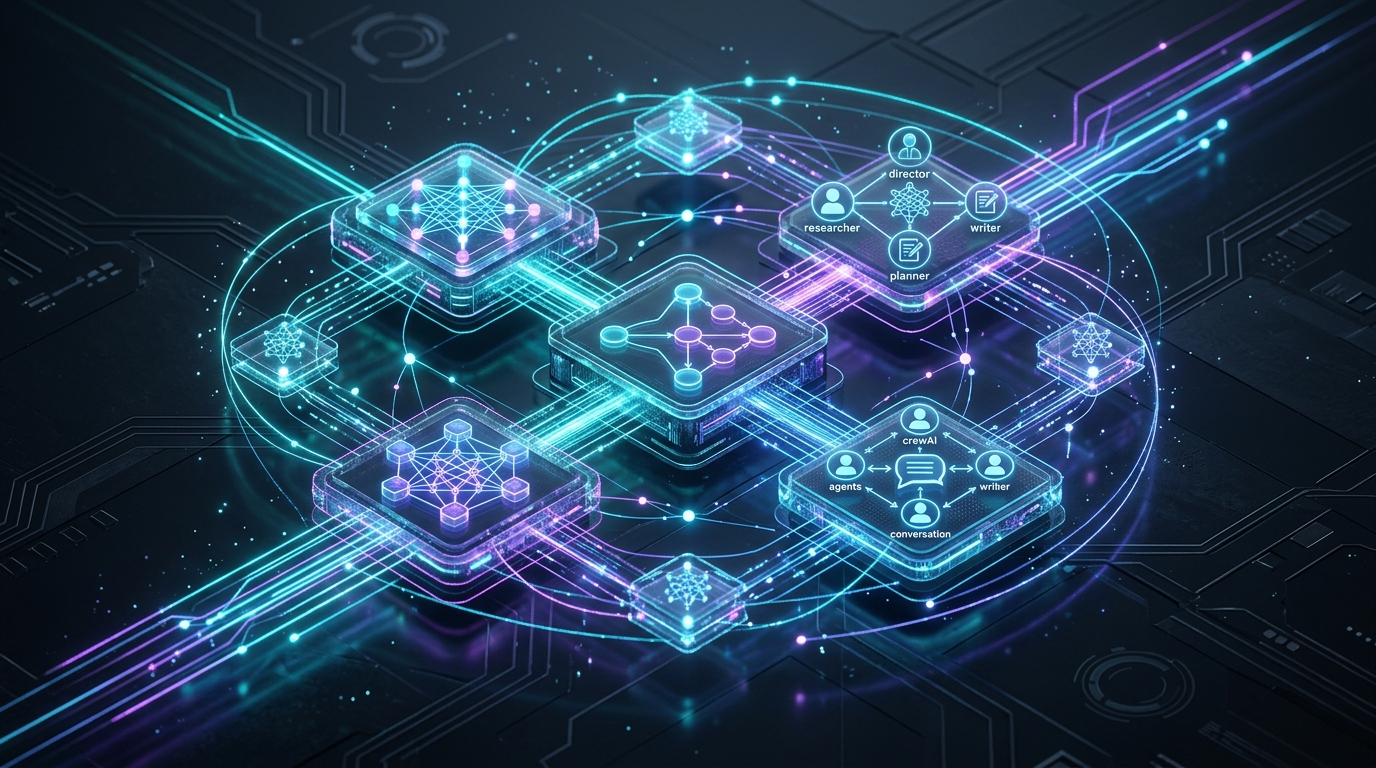
In 2026, building enterprise-grade autonomous AI systems no longer requires coding algorithms from scratch. A rich ecosystem of open-source AI agent frameworks has matured, offering pre-built orchestration engines, multi-agent communication protocols, and tool-calling infrastructure.
However, for CTOs, product leaders, and enterprise decision-makers, choosing the wrong framework can lead to non-deterministic loops, unexpected token cost overruns, and severe vendor lock-in.
This guide provides an executive-level evaluation of the top open-source AI agent frameworks in 2026—comparing LangGraph, CrewAI, Microsoft AutoGen, and LlamaIndex—focusing entirely on business reliability, orchestration control, compute costs (in both $ USD and ₹ INR), and production readiness without confusing code.
1. The Big 4 AI Agent Frameworks at a Glance
Each framework was engineered with a distinct architectural philosophy. Understanding these core design goals helps align the technology with your business objectives:
1. LangGraph
Stateful ControlBuilt on cyclical graph architecture. Delivers fine-grained control, human-in-the-loop validation, and extreme determinism for enterprise workflows.
2. CrewAI
Role-Based SquadsOrganizes AI agents like human teams (e.g., Researcher, Copywriter, Reviewer). Extremely fast to configure with clear role delegation.
3. Microsoft AutoGen
Conversational MeshEnables multi-agent conversational dialogue where agents debate, refine, and solve complex unstructured problems collaboratively.
4. LlamaIndex
Data-Centric RAGThe industry gold standard for connecting LLMs to complex private data sources, document lakes, and vector knowledge stores.
2. Comprehensive Framework Evaluation Matrix
Below is a side-by-side comparison across key enterprise parameters:
| Evaluation Dimension | LangGraph | CrewAI | Microsoft AutoGen | LlamaIndex Workflows |
|---|---|---|---|---|
| Primary Paradigm | Cyclical State Machine | Role-Based Crew Tasks | Multi-Agent Conversational Mesh | Data Query & Knowledge Graphs |
| Determinism & Control | Extreme (Highest) | Moderate | Low to Moderate | High (Data Retrieval) |
| Human-in-the-Loop | Native Checkpoints | Callback Hooks | User Proxy Agent | Query Interception |
| Token Efficiency | High (Optimized) | Moderate (Chatty) | Lower (High conversation) | High (Focused Retrieval) |
| Production Maturity | Enterprise Ready | Rapidly Maturing | Enterprise Ready | Enterprise Ready |
| Setup Speed | Moderate (Structured) | Very Fast (Plug & Play) | Moderate | Fast for Search |
3. Infrastructure & Operational Cost Analysis (USD & INR)
While open-source frameworks are free to download, executing multi-agent reasoning loops consumes LLM tokens and cloud infrastructure.
$200 – $600 / mo
₹16,500 – ₹50,000 / month
Internal document research, daily automated market summaries, and weekly reporting squads.
$1,200 – $3,500 / mo
₹1 Lakh – ₹2.9 Lakhs / month
24/7 Tier-1 customer resolution agents, automated inbound SDR lead research, and invoice parsing.
$4,500 – $12,000 / mo
₹3.7 Lakhs – ₹10 Lakhs / month
Dedicated NVIDIA GPU clusters running private Llama 3 / Mistral instances with zero data egress.
4. How to Prevent “Infinite Loops” and Token Waste in Production
A major risk in multi-agent orchestration is when autonomous agents enter recursive conversational loops without completing the objective, generating hundreds of dollars in unnecessary API costs.
Hard Iteration Caps & Timeouts
Set strict ceilings (e.g., maximum 5 reasoning steps per query) to terminate stuck loops instantly.
Hierarchical State Machines
Using state-graph frameworks like LangGraph ensures execution flows forward along verified transitions rather than open-ended chit-chat.
Real-Time Cost Anomaly Alerts
Automated kill-switches trigger if a single customer session exceeds $2.00 (~₹165) in LLM token consumption.
5. Which Framework Should Your Business Choose?
Finance, ERP & Legal
Choose **LangGraph**. When compliance and deterministic control are mandatory, cyclical graph state machines eliminate unexpected hallucinations.
Content, Marketing & Outbound
Choose **CrewAI**. Role-based task delegation allows creative and research squads to be assembled in days rather than months.
Enterprise Knowledge Base
Choose **LlamaIndex + LangGraph Hybrid**. Connect multi-million document repositories with precision retrieval and stateful action execution.
6. How Devzuno Builds Production-Grade AI Systems
Deploying an open-source framework is only 20% of the journey. The remaining 80% lies in data indexing, backend integrations, security guardrails, latency optimization, and intuitive UI dashboards.
At Devzuno Technologies, our senior AI architects select and customize the exact framework suited for your operational requirements, delivering turn-key enterprise systems with 100% intellectual property ownership.
Typical Implementation Package:
- Initial Prototype (PoC): $8,000 – $15,000 (~₹6.5 Lakhs – ₹12.5 Lakhs) delivered in 2 to 3 weeks.
- Full Enterprise Production: $25,000 – $60,000 (~₹20 Lakhs – ₹50 Lakhs) with custom integrations and dedicated SLAs.
7. Architect Your Enterprise AI Solution with Devzuno
Avoid costly trial-and-error with unproven AI architectures.
👉 Schedule a Framework Architecture Consultation with Devzuno’s senior software engineers to determine the optimal tech stack for your product.