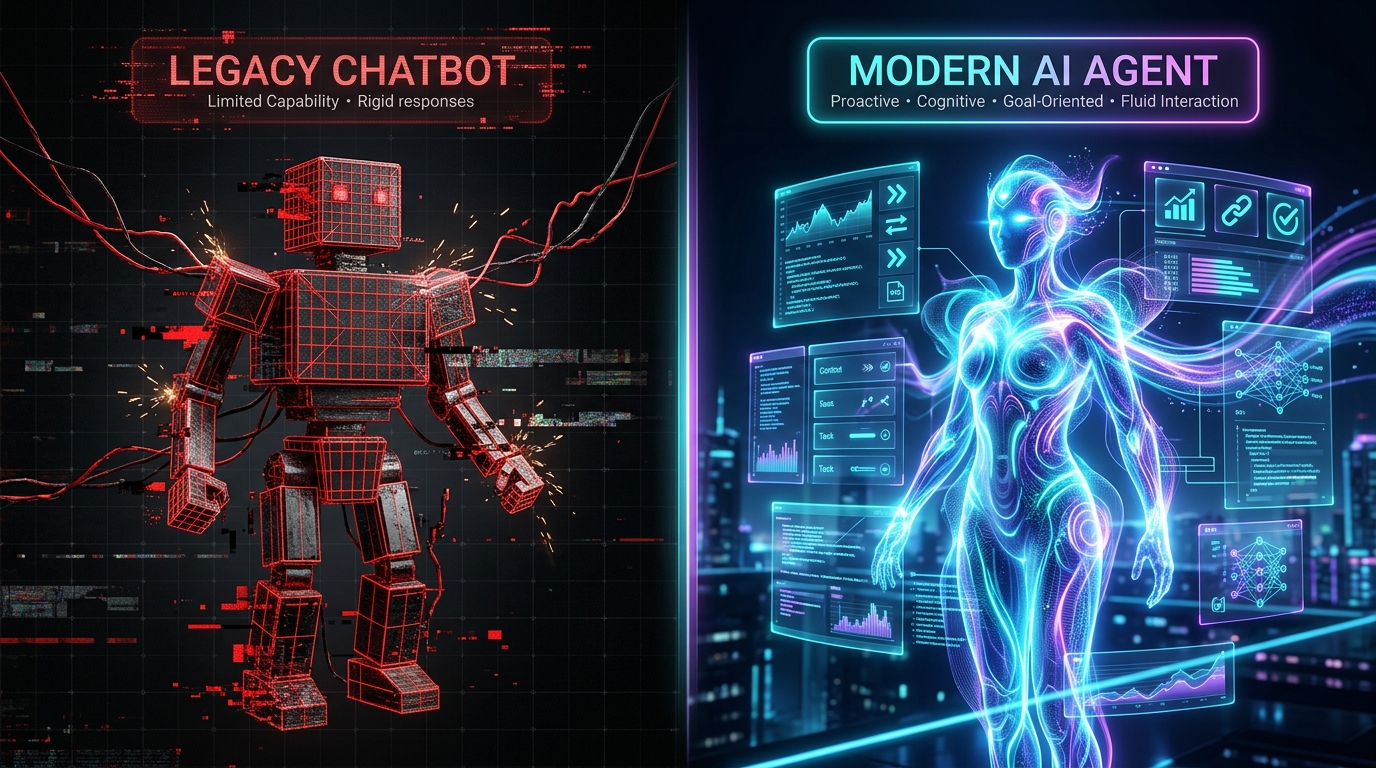
For nearly a decade, businesses relied on traditional chatbots to handle customer queries and internal employee inquiries. While these early tools promised instant support, the reality for most customers was frustrating: rigid decision trees, repetitive “I didn’t understand that, let me connect you to an agent” loops, and zero ability to execute real tasks.
In 2026, the era of static script-based bots is over. Forward-thinking enterprises are upgrading to Autonomous AI Agents—cognitive systems that understand context, access enterprise databases, make calculated decisions, and execute multi-step business actions without human hand-holding.
This strategic comparison breaks down the architectural, financial, and operational differences between traditional chatbots and modern AI agents—designed specifically for business leaders and customer experience executives.
1. The Core Paradigm Shift: Static Decision Trees vs. Autonomous Reasoning
To understand why traditional bots fail while AI agents succeed, examine the fundamental difference in how they process information:
Rule-Based Decision Trees
Relies on hardcoded keywords and static if-else branches. If a customer types a phrase not in the script, the bot fails immediately.
<div class="mt-5 space-y-2 border-t border-slate-200/80 pt-4 text-xs text-slate-600">
  <div class="flex items-center gap-2 text-rose-600"><span class="font-bold">✕</span> Zero reasoning or contextual deduction</div>
  <div class="flex items-center gap-2 text-rose-600"><span class="font-bold">✕</span> Cannot interact with third-party databases</div>
  <div class="flex items-center gap-2 text-rose-600"><span class="font-bold">✕</span> 78% escalation rate to human support</div>
</div>Goal-Driven Cognitive Reasoning
Understands intent and sentiment, queries live ERPs and CRMs, resolves requests end-to-end, and verifies company compliance.
<div class="mt-5 space-y-2 border-t border-cyan-500/20 pt-4 text-xs text-slate-600">
  <div class="flex items-center gap-2 text-blue-600 font-medium"><span class="font-bold">✓</span> Multi-step planning & autonomous tool calling</div>
  <div class="flex items-center gap-2 text-blue-600 font-medium"><span class="font-bold">✓</span> Native bidirectional integration with enterprise APIs</div>
  <div class="flex items-center gap-2 text-emerald-600 font-bold"><span class="font-bold">✓</span> 70%+ First-Contact Resolution (FCR)</div>
</div>
2. Comprehensive 10-Point Comparison Framework
Below is an executive-level feature matrix comparing legacy chatbots against custom AI agents:
| Feature Dimension | Traditional Rule-Based Chatbot | Autonomous AI Agent (Devzuno) |
|---|---|---|
| Input Understanding | Exact keyword matching & rigid intents | Nuanced natural language & sentiment context |
| Data Source Access | Static canned text responses | Real-time access to ERP, CRM, & SQL databases |
| Action Execution | Limited to sending FAQ links | Executes refunds, bookings, and account updates |
| Multi-Turn Context | Forgets previous messages quickly | Persistent organizational & user session memory |
| Maintenance Overhead | Requires constant manual script updates | Self-adapting knowledge base ingestion |
| Handling Edge Cases | Immediate loop error or dead end | Calculated problem-solving with fallback guardrails |
| Integration Depth | Basic website chat widgets | Omnichannel: WhatsApp, Teams, Slack, Email, Web |
| Human Escalation | Dumps raw chat transcript onto human | Provides summarized briefing with suggested actions |
| Resolution Rate | 15% – 25% automated resolution | 65% – 85% end-to-end automated resolution |
| Customer CSAT Score | Low (creates user friction & frustration) | High (delivers sub-minute instant resolutions) |
3. Real-World Scenario: How Both Systems Handle a Customer Request
To see the stark difference in user experience, consider a common e-commerce support request:
“Hey, my order #84920 was supposed to arrive yesterday for my daughter’s birthday party today, but tracking hasn’t updated. Can you expedite it or let me pick it up at a local warehouse?”
Traditional Chatbot Response:
Trigger keyword: "tracking"Result: Fails completely to address the urgency, warehouse pickup, or specific delay.
Devzuno Autonomous AI Agent Response:
Verified identity & carrier API in 800msHowever, because of the birthday party today, I can authorize an immediate pickup at our Central Distribution Hub (Aisle 4, Bay C) before 4:00 PM today. Would you like me to hold the package at the warehouse and issue you a VIP pickup barcode right now?"
Result: Instant proactive resolution, zero human intervention required, 100% customer delight.
4. Key Business Indicators That Signal It’s Time to Upgrade
If your business experiences any of the following 4 warning signs, your current chatbot is likely costing you more in lost customers and support salaries than it saves:
More than 50% of incoming chats end up requiring a human agent because the bot fails to resolve multi-sentence inquiries.
Your operations team spends dozens of hours every month manually creating new decision tree branches and keyword rules.
Your bot can only send documentation links, but cannot modify customer records, process refunds, or reschedule appointments.
Customers express vocal frustration with the chatbot, repeatedly typing "agent" or "human" to bypass the bot completely.
5. Transition Strategy: Migrating from Legacy Chatbots to AI Agents
Transitioning to autonomous AI agents does not require an all-or-nothing system replacement. Devzuno recommends a phased, de-risked migration path:
Knowledge Ingestion & Policy Ingestion
Index your helpdesk logs, SOPs, and policy docs into a secure private vector knowledge base.
Read-Only Copilot Mode
The AI agent operates alongside your human support team, drafting suggested responses for human review.
Tool & API Integration
Grant the agent controlled read-and-write permissions to perform low-risk tasks (e.g., address updates, order lookups).
Full Autonomous Tier-1 Resolution
The agent autonomously resolves 70%+ of inbound inquiries, only escalating complex edge cases to human managers.
6. How Devzuno Transforms Your Customer Experience
At Devzuno Technologies, we engineer enterprise-grade AI agents tailored to your business rules, compliance requirements, and existing software infrastructure.
What You Get with a Devzuno AI Agent Deployment:
- Custom Enterprise Knowledge Base: Zero hallucinations with deterministic business guardrails.
- Bi-Directional API Tool Orchestration: Real-time synchronization with Salesforce, Zendesk, SAP, Shopify, and custom SQL databases.
- 100% Data Privacy & Security: Your proprietary data is never used to train public models.
- Guaranteed First-Contact Resolution (FCR) Improvement: Slashing support costs by 50% within 90 days.
7. Upgrade from Outdated Chatbots Today
Don’t let rigid chatbots damage your customer relationships and inflate your operational payroll.
👉 Book a 30-Minute AI Agent Consultation with Devzuno’s senior software architects to test our live demo agents and receive a custom migration plan.