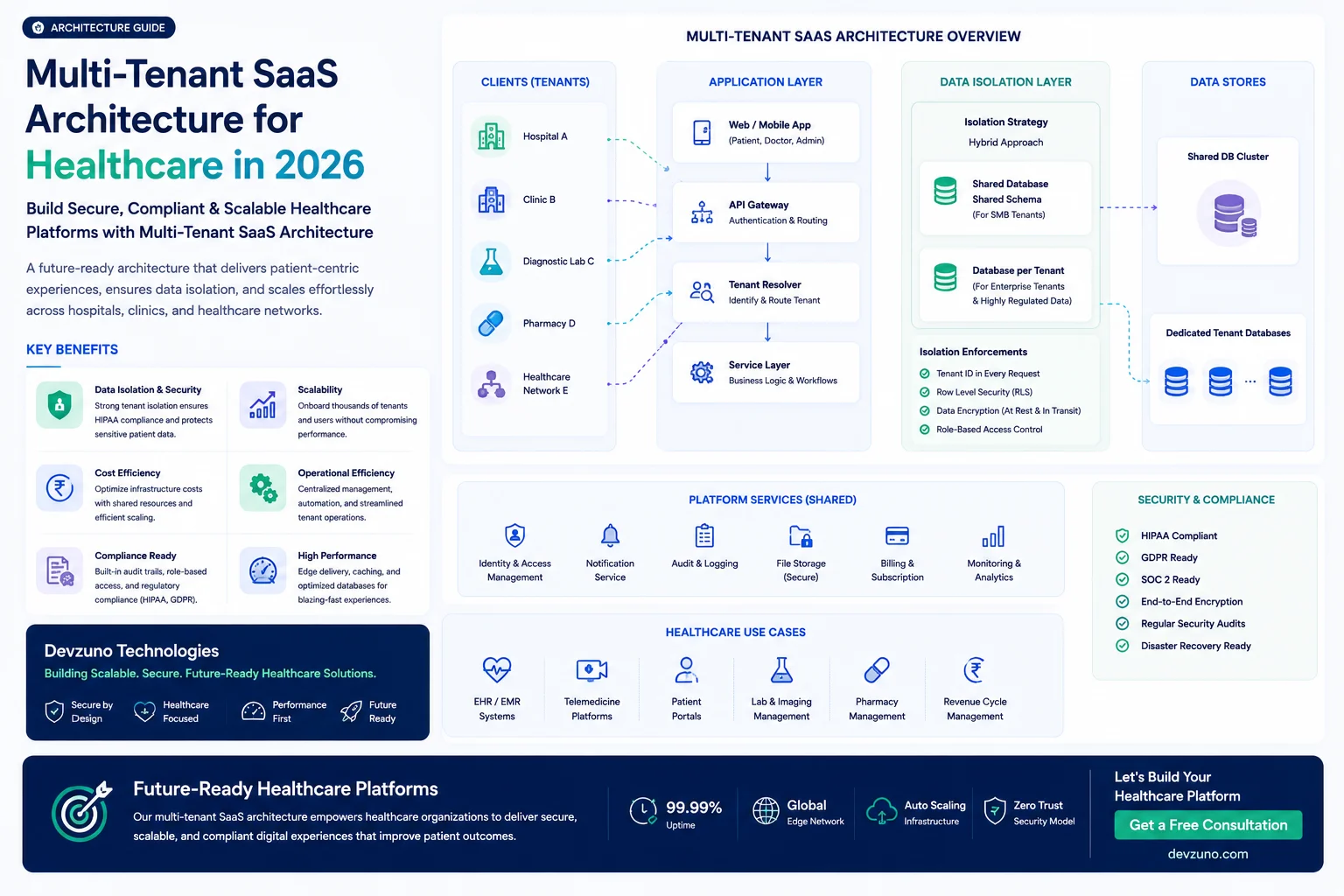
Building a software-as-a-service (SaaS) platform that serves thousands of distinct business customers (tenants) from a single cloud codebase requires meticulous database isolation, tenant-aware security, and resilient cloud architecture.
In regulated verticals like Healthcare (hospitals, diagnostic clinics, digital health startups) and Education (school chains, universities, EdTech platforms), multi-tenancy is particularly complex. Developers must guarantee strict patient data isolation, comply with national healthcare frameworks (such as ABDM in India or HIPAA internationally), and support high-volume recurring fee billing.
Partnering with an enterprise software engineering company like Devzuno Technologies ensures your multi-tenant SaaS platform is engineered for global scale, enterprise-grade data isolation, and sub-second response times.
1. Core Principles of Multi-Tenant SaaS Architecture
Multi-tenancy is an architectural model where a single software instance serves multiple client organizations (tenants). Each tenant’s data, configuration settings, user roles, and operational workflows remain completely isolated from other tenants sharing the physical hardware infrastructure.
┌───────────────────────────────────────────────────────────────────────────┐
│                    GLOBAL API GATEWAY / REVERSE PROXY                     │
│    (Tenant Routing by Subdomain: clinicA.saas.com / schoolB.saas.com)     │
└─────────────────────────────────────┬─────────────────────────────────────┘
                                      │
                                      ▼
┌───────────────────────────────────────────────────────────────────────────┐
│                SHARED APPLICATION SERVER LAYER (Node.js / Go)             │
│            (Tenant Middleware Context Injection & Token Validation)        │
└───────────────────────────┬───────────────────┬───────────────────────────┘
                            │                   │
                            ▼                   ▼
┌──────────────────────────────────┐  ┌──────────────────────────────────┐
│  DATABASE PATTERN 1: SHARED DB   │  │ DATABASE PATTERN 2: SEPARATE DB  │
│  (Filtered by tenant_id column)  │  │  (Isolated DB per Enterprise)    │
└──────────────────────────────────┘  └──────────────────────────────────┘
Why Multi-Tenancy Beats Single-Tenancy for SaaS Platforms:
- Drastic Infrastructure Cost Savings: Instead of deploying separate cloud servers for every customer, multi-tenancy maximizes server CPU and RAM utilization across shared clusters.
- Instant Feature Updates: Continuous Integration / Continuous Deployment (CI/CD) pipelines push updates, security patches, and new features to all tenants simultaneously.
- Centralized Data Telemetry: Operational metrics, usage analytics, and billing audits can be monitored from a centralized master admin portal.
2. Deep-Dive: The 3 Database Multi-Tenancy Patterns
The database architecture is the most critical decision when engineering multi-tenant SaaS platforms. Below is an exhaustive comparison of the three primary database isolation models:
| Database Isolation Model | Technical Implementation | Data Security & Isolation | Scalability & Cost Efficiency | Best Suited For |
|---|---|---|---|---|
| 1. Shared Database, Shared Schema | All tenants share one database; every SQL query filters by tenant_id column. | Moderate (Requires strict ORM middleware to prevent data leaks) | Highest Cost Efficiency & Easiest Maintenance | Mid-Market B2B SaaS, EdTech, Standard SaaS MVPs |
| 2. Shared Database, Separate Schemas | One database instance, but each tenant receives a separate database schema (e.g., PostgreSQL tenant_a.users). | Strong (Schema-level logical separation) | Moderate (Higher database connection pool overhead) | Healthcare Networks, Mid-Tier Diagnostic Labs |
| 3. Database-per-Tenant | Every tenant receives a dedicated isolated database instance (PostgreSQL / MongoDB). | Maximum (Complete physical data isolation) | Higher Infrastructure Cost & Complex Migrations | Large Enterprise Hospitals, Government Institutions |
How Devzuno Enforces Tenant Data Isolation
To prevent the catastrophic scenario of Tenant A viewing Tenant B’s sensitive records, Devzuno implements Row-Level Security (RLS) in PostgreSQL combined with custom tenant middleware context injection:
-- PostgreSQL Row-Level Security (RLS) Policy Example
ALTER TABLE patient_records ENABLE ROW LEVEL SECURITY;

CREATE POLICY tenant_isolation_policy ON patient_records
    USING (tenant_id = current_setting('app.current_tenant_id'));
3. Enterprise SSO & Identity Federation (SAML 2.0 / Okta / Azure AD)
Large hospital networks and university campuses demand Single Sign-On (SSO) integration so staff can authenticate using their existing corporate identity providers:
- SAML 2.0 & OIDC Federation: Enabling enterprise tenants to link their Okta, Microsoft Azure AD, or Google Workspace identity directory directly to your SaaS platform.
- Domain-Based Auto-Routing: When a user types
doctor@apollohospital.com, the SaaS auth gateway identifies the domain@apollohospital.comand automatically redirects the user to Apollo Hospital’s internal SSO login portal.
4. Multi-Tenant Event-Driven Webhooks & Message Queues
When building B2B SaaS products, tenant organizations require real-time integrations with their external tools via webhooks:
[Core SaaS Action (e.g. Invoice Paid)] ➔ [AWS EventBridge / Kafka] ➔ [Tenant Webhook Dispatcher] ➔ [Tenant External Endpoint (Zapier / ERP)]- Isolated Worker Queues: Utilizing RabbitMQ / AWS SQS queues to process tenant background jobs (e.g., generating PDF reports or firing webhooks) so a bulk export by Tenant A does not delay real-time alerts for Tenant B.
- Retry & Dead Letter Queues (DLQ): Implementing exponential backoff retries and signature verification headers (
X-SaaS-Signature) to guarantee secure webhook delivery.
5. Database Schema Migration Strategies in Multi-Tenant Systems
Rolling out database schema migrations (e.g., adding a new SQL column or updating table indexes) across thousands of tenant schemas without downtime requires careful orchestration:
- Blue/Green Schema Migrations: Applying non-breaking schema additions (adding nullable columns) first, updating application code, and dropping deprecated columns in a secondary release phase.
- Asynchronous Tenant Migration Workers: For Database-Per-Tenant models, background queue workers (BullMQ / Celery) execute SQL migrations sequentially tenant by tenant, preventing database lock bottlenecks.
6. Tenant Rate Limiting & Quota Management (Redis Sliding Window)
To prevent a single high-volume tenant from monopolizing server resources (the “Noisy Neighbor” problem), multi-tenant platforms require strict rate limiting algorithms:
- Sliding Window Rate Limiting: Tracking API request counts per tenant ID inside Redis. If Tenant A exceeds 500 requests per minute, subsequent requests return HTTP 429 (Too Many Requests) without affecting Tenant B.
- Dynamic Tier Quotas: Enforcing operational limits based on subscription plans (e.g., Free Tier: 1,000 monthly active students; Enterprise Tier: Unlimited students & priority queue processing).
7. High-Concurrency Database Connection Pooling (PgBouncer & Prisma)
In multi-tenant SaaS environments, handling database connection pools across thousands of concurrent tenant requests can cause database RAM exhaustion if not managed correctly.
Connection Management Strategy:
- PgBouncer Connection Pooling: Deploying PgBouncer in front of PostgreSQL to pool and reuse active database connections, enabling 10,000+ API clients to communicate with PostgreSQL using under 100 actual database connections.
- Read-Replicas & Sharding: Separating heavy read operations (e.g., generating monthly student report cards or diagnostic analytics) to read-replica databases while directing write operations to the primary master database.
8. Specialized Multi-Tenant Architecture for Healthcare & Diagnostics
Healthcare SaaS platforms demand zero tolerance for data leaks, sub-second lab report rendering, and strict regulatory compliance:
[Patient / Doctor Mobile App] ➔ [API Gateway] ➔ [FHIR / ABDM Adapter Engine] ➔ [Encrypted Tenant Database] ➔ [AWS S3 Medical Image Vault (DICOM)]A. ABDM (Ayushman Bharat Digital Mission) & ABHA ID Integration
In India, modern healthcare SaaS platforms must integrate with the ABDM digital health stack:
- ABHA Health ID Creation: Generating and verifying 14-digit ABHA numbers via Aadhaar and mobile OTP authentication.
- HIP/HIU Health Data Exchange: Functioning as a Health Information Provider (HIP) and Health Information User (HIU) to exchange digital health records via standardized HL7 / FHIR APIs.
B. DICOM Medical Imaging Vaults
X-Ray, MRI, and CT scan files stored in DICOM format require dedicated storage architectures. Devzuno engineers secure object storage pipelines utilizing AWS S3 Glacier and CloudFront signed URLs to stream high-resolution medical imagery securely to doctor dashboards.
C. HIPAA & DPDP Act Data Safeguards
- Field-Level Encryption: Sensitive Personally Identifiable Information (PII) and Protected Health Information (PHI) encrypted with AES-256 keys prior to database insertion.
- Audit Trails: Immutable audit logging recording every view, export, or edit of patient records with timestamp and IP origin metrics.
9. Specialized Multi-Tenant Architecture for EdTech & School Operating Systems
School operating systems and EdTech platforms serve multi-campus educational networks with distinct student, parent, teacher, and administrative role permissions:
A. Dynamic Tenant Routing & White-Label Customization
Educational institutions demand custom branding. Devzuno’s multi-tenant architecture supports dynamic subdomains (dps.schoolthinker.com or custom CNAME domains portal.dpslucknow.org) with tenant-specific CSS themes, logos, and report card templates loaded dynamically from CDN caches.
B. Scalable Automated Fee Collection Rails
- Multi-Gateway Merchant Routing: Routing fee transactions to each school’s distinct Razorpay, PhonePe, or Paytm merchant account.
- Automated Installment Schedules: Triggering automated WhatsApp and SMS payment reminders for quarterly tuition fees with auto-generated digital receipts.
C. Real-Time Virtual Classrooms & Attendance
- WebRTC Live Streaming: Integrating Zoom / Jitsi APIs for live interactive classrooms.
- QR & Geofence Attendance: Mobile app integration allowing teachers to scan student QR badges or verify staff location via GPS geofencing.
10. Tenant Routing, Authentication & RBAC Design
Managing authentication across thousands of tenants requires a centralized identity architecture:
┌───────────────────────────────────────────────────────────────────────────┐
│                       CENTRAL AUTH SERVICE (OAuth 2.0)                    │
│      (Validates User Credentials, Resolves Tenant ID, Signs JWT Token)    │
└─────────────────────────────────────┬─────────────────────────────────────┘
                                      │
                                      ▼
┌───────────────────────────────────────────────────────────────────────────┐
│                      STRUCTURED JWT PAYLOAD SAMPLE                        │
│  { "user_id": "usr_99", "tenant_id": "tnt_lucknow_hospital", "role": "DOCTOR" }│
└───────────────────────────────────────────────────────────────────────────┘
Role-Based Access Control (RBAC) Matrix:
We implement granular RBAC policies defining exact permissions for administrative roles:
- Super Admin: Full platform management across all tenant organizations.
- Tenant Admin: Management restricted strictly to their organization’s staff, billing, and settings.
- Standard User (Doctor / Teacher): Access limited to assigned patients, classes, or departments.
- End Consumer (Patient / Student / Parent): Self-service portal view restricted to personal records.
11. Multi-Region Replication & Data Sovereignty Architecture
For global SaaS platforms serving healthcare networks in both North America and India, data sovereignty laws dictate where data must reside geographically:
- Geographic Data Pinning: Routing Indian patient records to AWS Mumbai (
ap-south-1) region and US patient records to AWS N. Virginia (us-east-1) region based on tenant configuration settings. - Global Edge Acceleration: Utilizing Cloudflare Global Anycast Network to route static assets, while dynamic API calls execute within regional compliance boundaries.
12. Data Retention Policies & Compliance Reporting
Maintaining regulatory compliance across multi-tenant platforms requires automated lifecycle management:
- Configurable Tenant Retention Windows: Allowing hospital administrators to configure data retention windows (e.g., retaining patient records for 7 years according to medical compliance laws before auto-archiving to AWS S3 Glacier).
- Automated SOC 2 Compliance Exports: Generating one-click security compliance audit reports for enterprise clients detailing access logs, encryption settings, and backup verification metrics.
13. Disaster Recovery, Backup & Data Archival
Enterprise clients in healthcare and education mandate strict Recovery Point Objectives (RPO) and Recovery Time Objectives (RTO):
- Automated Tenant Backups: Point-in-Time Recovery (PITR) enabling database restores to any specific second in the past 35 days.
- Isolated Tenant Exports: Automated data export pipelines allowing tenant administrators to download complete JSON/SQL backups of their data upon request.
- Right-To-Be-Forgotten Compliance: Automated deletion workers that purge tenant data across primary databases, backups, and vector indices in compliance with privacy regulations.
14. High-Availability Cloud Infrastructure & CI/CD Pipelines
To guarantee 99.99% uptime, Devzuno deploys multi-tenant SaaS backends using containerized microservices and automated infrastructure-as-code:
[Route 53 DNS] ➔ [AWS ALB Load Balancer] ➔ [Kubernetes EKS Cluster] ➔ [Aurora PostgreSQL Serverless (Auto-Scaling)] ➔ [Redis Cluster]A. Auto-Scaling Kubernetes Clusters
Deploying Node.js or Go microservices inside Docker containers managed by Amazon EKS (Kubernetes). When traffic spikes during morning school attendance or hospital OPD hours, node clusters auto-scale dynamically.
B. Zero-Downtime Blue/Green Deployments
Using CI/CD pipelines (GitHub Actions / GitLab CI) with Blue/Green deployment strategies. New code updates are deployed to staging containers and verified before traffic is switched instantly, eliminating platform downtime.
15. Observability, Telemetry & Tenant Performance Monitoring
Monitoring multi-tenant SaaS requires tracking metrics on a per-tenant basis:
- Distributed Tracing (OpenTelemetry + Jaeger): Tracking API request spans across microservices to isolate latency bottlenecks for specific tenant accounts.
- Prometheus & Grafana Dashboards: Visualizing real-time CPU usage, DB query latency, memory consumption, and API error rates broken down by
tenant_id.
16. Real-World Case Study: Devzuno’s School Thinker OS
School Thinker OS is Devzuno’s flagship EdTech SaaS product engineered for school networks:
- Scale: Serves over 50+ educational campuses and 100,000+ active students on a single multi-tenant cluster.
- Architecture: Shared PostgreSQL database with Row-Level Security, Redis caching layer, and dynamic white-label subdomain routing.
- Results: Processes over ₹10 Crores in annual tuition fee payments seamlessly with 99.99% uptime.
17. Cost & Infrastructure Breakdown for 100 SaaS Tenants
Below is an estimated monthly cloud infrastructure cost breakdown on AWS for serving 100 active business tenants (approx. 50,000 active monthly users):
| Cloud Component | Service Specs | Estimated Monthly Cost (USD) |
|---|---|---|
| Compute Cluster | AWS EKS (2 x t4g.medium Worker Nodes) | $75.00 |
| Primary Database | AWS Aurora PostgreSQL (2 vCPU, 8GB RAM Serverless) | $120.00 |
| Caching Layer | ElastiCache Redis Cluster | $35.00 |
| CDN & Storage | CloudFront + S3 (500GB DICOM/PDF storage) | $45.00 |
| Total Cloud Infra | High-Availability Multi-Tenant Cluster | ~$275.00 / month |
18. Devzuno’s Multi-Tenant SaaS Engineering Lifecycle
Building an enterprise SaaS product requires a proven engineering process:
Stage 1: Multi-Tenancy Strategy & Domain Modeling (Weeks 1-2)
  └── Stage 2: Database Schema & Isolation Architecture (Weeks 3-4)
        └── Stage 3: Core SaaS Platform & Tenant Routing Development (Weeks 5-10)
              └── Stage 4: Vertical Integrations (ABDM / Payments / Video) (Weeks 11-14)
                    └── Stage 5: Security Audits & Load Performance Testing (Weeks 15-16)
19. Frequently Asked Questions (FAQs)
Q1. What is the difference between single-tenant and multi-tenant SaaS architecture?
Single-tenant architecture deploys dedicated code and database servers for each individual client organization. Multi-tenant architecture serves multiple client organizations from a single shared software codebase and database cluster, cutting cloud infrastructure costs by up to 70%.
Q2. How do you prevent one tenant from accessing another tenant’s medical or educational data?
We enforce strict multi-layer security: Row-Level Security (RLS) in PostgreSQL, context-injected ORM middleware, field-level database encryption, and automated unit tests that verify tenant boundary enforcement on every API route.
Q3. Can enterprise customers request custom features without affecting other SaaS tenants?
Yes! We implement Feature Flag Systems (e.g., LaunchDarkly or custom flags) that enable specific features, integrations, or UI modules for individual premium tenants without branching or breaking the core shared codebase.
Q4. What tech stack does Devzuno recommend for multi-tenant SaaS platforms?
We recommend Astro / Next.js / React for high-speed frontends, Node.js (TypeScript) or Go (Golang) for high-concurrency microservices, PostgreSQL (with RLS) or MongoDB for databases, and AWS Kubernetes (EKS) for cloud auto-scaling.
Q5. How do we start building a multi-tenant SaaS product with Devzuno?
Contact the SaaS engineering leads at Devzuno Technologies to schedule a technical architecture consultation. We will evaluate your product roadmap and deliver a technical design document (SRS), database isolation plan, and fixed milestone proposal.
Ready to Build a Scalable Multi-Tenant SaaS Platform?
Partner with North India’s premier SaaS engineering team. Contact Devzuno Technologies today to consult with our principal cloud architects.