
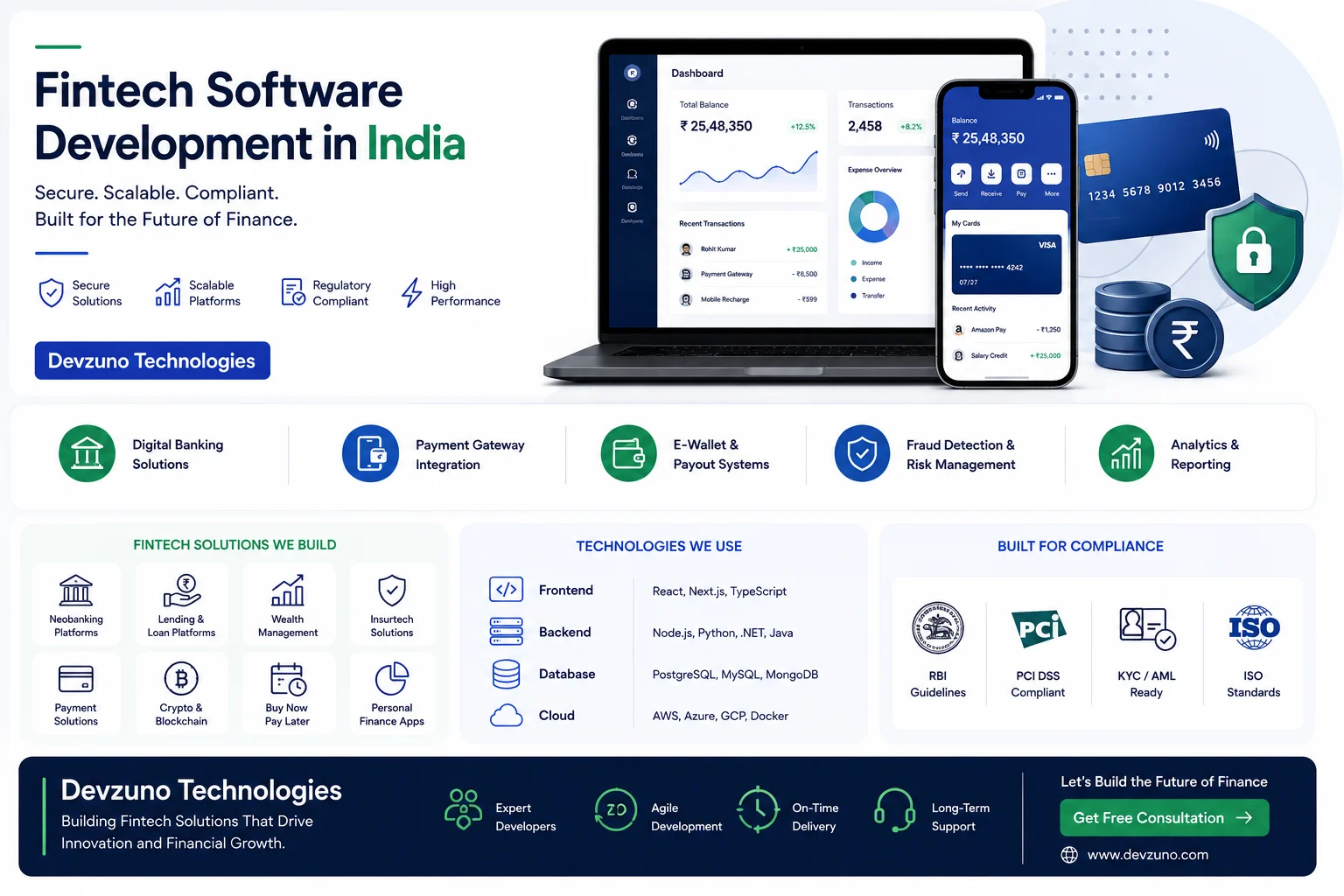
India has revolutionized the global digital payments landscape. Driven by the National Payments Corporation of India (NPCI), the Unified Payments Interface (UPI), and RBI payment aggregator frameworks, digital financial transactions have reached unprecedented daily volumes.
For FinTech startups, NBFCs (Non-Banking Financial Companies), neo-banks, and enterprise e-commerce platforms, building robust FinTech software and payment engine architecture requires far more than basic API integration. Engineering modern financial software demands sub-second transaction routing, double-entry immutable ledgers, real-time fraud detection, and strict compliance with Reserve Bank of India (RBI) data localization mandates.
Partnering with an enterprise financial engineering firm like Devzuno Technologies enables companies to build bulletproof, high-concurrency FinTech platforms designed to process millions of transactions without data loss or reconciliation errors.
1. The Indian FinTech & Digital Payments Landscape (2026)
Digital financial adoption in India operates on world-leading rails:
- UPI & UPI AutoPay Mandates: Over 13 Billion monthly UPI transactions across India, with automated recurring mandates driving subscription billing for SaaS, OTT, and insurance portals.
- RBI Payment Aggregator (PA) Guidelines: Strict regulatory frameworks mandating direct merchant settlement, escrow account management, and zero card-on-file storage without tokenization.
- Account Aggregator (AA) Ecosystem: Consents-based financial data sharing enabling instant credit scoring, loan underwriting, automated credit risk evaluation, and personal finance management (PFM).
- Data Localisation Mandates: Mandating that all financial transaction logs, cardholder data, and user payment credentials reside physically within Indian cloud servers.
2. Core Architectural Components of an Enterprise Payment Engine
Building a scalable FinTech engine requires a resilient, multi-tiered microservices architecture:
┌───────────────────────────────────────────────────────────────────────────┐
│                       CLIENT PAYMENT INTERFACE                            │
│           (Mobile SDK / Web Checkout / UPI Intent Deep Linking)           │
└─────────────────────────────────────┬─────────────────────────────────────┘
                                      │
                                      ▼
┌───────────────────────────────────────────────────────────────────────────┐
│                    API GATEWAY & FRAUD DETECTION ENGINE                   │
│        (Token Validation, IP Risk Scoring, Redis Velocity Checks)          │
└─────────────────────────────────────┬─────────────────────────────────────┘
                                      │
                                      ▼
┌───────────────────────────────────────────────────────────────────────────┐
│                      PAYMENT ROUTER & SWITCH MODULE                       │
│    (Smart Fallback: Razorpay ➔ Cashfree ➔ PhonePe ➔ Direct Bank H2H)     │
└───────────────────────────┬───────────────────┬───────────────────────────┘
                            │                   │
                            ▼                   ▼
┌──────────────────────────────────┐  ┌──────────────────────────────────┐
│ DOUBLE-ENTRY LEDGER (PostgreSQL) │  │ ASYNC SETTLEMENT & RECON ENGINE  │
│(Immutable Transaction Log & ACID)│  │ (Bank Statement Parsing & Webhooks)│
└──────────────────────────────────┘  └──────────────────────────────────┘
A. Client Payment SDK & UPI Intent Deep-Linking
Enabling seamless mobile checkouts by initiating direct app-to-app deep-linking (Google Pay, PhonePe, Paytm, BHIM) via NPCI’s upi://pay URI specs, eliminating manual VPA typing.
B. Smart Payment Gateway Router & Cascading Fallback
To maximize transaction success rates, Devzuno engineers dynamic payment routing engines. If Gateway A (e.g., Razorpay) experiences bank downtime, the router cascades the transaction payload to Gateway B (Cashfree) or Gateway C (PhonePe) within 200 milliseconds without user disruption.
C. Circuit Breaker Resilience Patterns
To prevent cascading API failures when third-party banking nodes crash, we implement Circuit Breaker Patterns (using Hystrix or Resilience4j logic in Go/Node.js). If Bank A’s API times out 5 consecutive times, the circuit opens instantly and reroutes all traffic to Bank B for 60 seconds before probing health recovery.
3. Sub-Merchant Onboarding & Card-on-File Tokenization (CoFT)
For Payment Aggregators (PA) and multi-vendor marketplaces, onboarding sub-merchants requires compliance with RBI Tokenization rules:
- Card-on-File Tokenization (CoFT): Integrating directly with card networks (Visa Token Service, Mastercard Digital Enablement Service, RuPay Tokenization) to issue network tokens. Raw 16-digit PANs are never stored in your database.
- Sub-Merchant KYB & Onboarding APIs: Automated Business KYC verification (PAN, GSTIN, Bank Account Name Match) before granting sub-merchants payment collection capabilities.
4. Embedded Finance & Embedded Insurance APIs
Modern e-commerce and SaaS platforms are increasingly embedding financial products directly into user checkout flows:
- Embedded Insurance APIs: Integrating IRDAI-compliant micro-insurance APIs (e.g., transit insurance, flight delay insurance, product warranty) with instant policy document generation.
- Embedded Point-of-Sale (POS) Credit & BNPL: Integrating Buy-Now-Pay-Later (BNPL) checkout options (LazyPay, ZestMoney, Flexmoney) with sub-second loan eligibility scoring.
5. Multi-Currency Settlement & Dynamic Currency Conversion (DCC)
For cross-border FinTech applications accepting international credit cards (Visa / Mastercard):
- Real-Time FX Rate Engine: Fetching live foreign exchange rates (USD, EUR, GBP, AED to INR) with configurable merchant margin markups.
- Dynamic Currency Conversion (DCC): Allowing international buyers to view prices and pay in their local currency while settling in INR to Indian merchant accounts.
6. Double-Entry Database Ledger Architecture
In FinTech systems, financial precision is paramount. Below is an example of an immutable double-entry database schema in PostgreSQL:
-- Double-Entry Financial Ledger Schema
CREATE TABLE ledger_accounts (
    account_id UUID PRIMARY KEY,
    tenant_id VARCHAR(64) NOT NULL,
    account_type VARCHAR(32) NOT NULL, -- 'ASSET', 'LIABILITY', 'EQUITY', 'REVENUE'
    currency VARCHAR(3) DEFAULT 'INR',
    created_at TIMESTAMP WITH TIME ZONE DEFAULT CURRENT_TIMESTAMP
);

CREATE TABLE journal_entries (
    entry_id UUID PRIMARY KEY,
    transaction_reference VARCHAR(128) UNIQUE NOT NULL,
    description TEXT,
    created_at TIMESTAMP WITH TIME ZONE DEFAULT CURRENT_TIMESTAMP
);

CREATE TABLE ledger_postings (
    posting_id UUID PRIMARY KEY,
    entry_id UUID REFERENCES journal_entries(entry_id),
    account_id UUID REFERENCES ledger_accounts(account_id),
    amount NUMERIC(18, 4) NOT NULL, -- Positive for Credit, Negative for Debit
    CHECK (amount <> 0)
);
Key Ledger Invariants Enforced by Devzuno:
- Zero-Sum Ledger Rule: The sum of all debits must equal the sum of all credits for every transaction journal entry (
SUM(amount) = 0). - Immutable Audit Trail: Ledger posting records are
INSERT-only. Modifying or deleting existing ledger rows is strictly forbidden at the database trigger level. Reversals require issuing a balancing refund entry.
7. Digital Lending: Loan Origination (LOS) & Management (LMS) Architecture
For NBFCs and digital lending FinTechs, building automated Loan Origination Systems (LOS) and Loan Management Systems (LMS) requires real-time credit scoring algorithms:
[Borrower Loan Application] ➔ [Credit Bureau API (CIBIL / Experian)] ➔ [Automated Underwriting Engine] ➔ [E-Mandate / eSign (Aadhaar)] ➔ [Automated Disbursal API]A. Real-Time Credit Bureau Integrations
Automated API connections to Indian credit bureaus (CIBIL, Experian, CRIF High Mark, Equifax) to pull credit scores, repayment histories, and existing active loan liabilities in sub-3 seconds.
B. Digital eSign & eKYC Pipelines
- Aadhaar eKYC & Video KYC (V-KYC): Seamless verification of borrower identity via UIDAI Aadhaar OTP and automated V-KYC video recording pipelines.
- Aadhaar eSign (eMudhra / NSDL): Digital execution of loan agreements using legally binding Aadhaar-based OTP signatures.
8. Neo-Banking, Open Banking & Escrow Settlement Rails
Modern FinTech platforms require deep integrations with traditional core banking systems (CBS) via corporate API banking rails:
- Virtual Account Generation: Dynamically generating unique virtual bank account numbers (e.g.,
DEVZUNO99812) for automated customer payment collection via NEFT, RTGS, and IMPS. - Escrow Account Automated Settlements: Managing RBI-compliant nodal and escrow account disbursements for Payment Aggregators (PA), ensuring T+1 or T+2 automated merchant payouts.
- Instant Payouts & Disbursals: Automated bulk payouts to vendor bank accounts via direct Host-to-Host (H2H) banking APIs with automated penny-drop bank account verification.
- Account Aggregator (AA) Integration: Consuming financial data consent artefacts from RBI-regulated Account Aggregators (like Setu, Anumati, Finvu) to fetch bank statement data for instant digital loan underwriting.
9. Real-Time Fraud Detection, Risk Engine & AML Screening
Preventing fraudulent transactions, card testing attacks, and stolen credential abuse requires automated velocity checking:
[Incoming Checkout API Request] ➔ [Redis Velocity Check] ➔ [Device Fingerprint Audit] ➔ [AI Risk Score Evaluator] ➔ [Pass / Request 3D Secure OTP / Block]Risk Evaluation Metrics Implemented by Devzuno:
- Velocity Rate Limiting: Tracking transaction frequency per IP, device fingerprint, and VPA address within sliding 60-second Redis windows.
- Geographic Anomaly Detection: Flagging transactions originating from IP locations inconsistent with user historical profiles.
- AML & PEP Sanction Screening: Automated API cross-referencing against global Anti-Money Laundering (AML) databases and Politically Exposed Persons (PEP) watchlists prior to account onboarding.
- AI Machine Learning Risk Inference: Scoring transactions in under 15ms using lightweight ONNX micro-models trained on historical chargeback patterns.
10. Encryption, Key Management & Hardware Security Modules (HSM)
Securing sensitive financial payloads requires enterprise-grade cryptographic architecture:
- Payload Encryption (RSA 4096 / AES-256-GCM): Encrypting sensitive API request parameters prior to network transmission.
- AWS KMS & Hardware Security Modules (HSM): Managing cryptographic master keys inside dedicated, FIPS 140-2 Level 3 validated Hardware Security Modules to prevent key theft.
- HMAC Request Signing & Idempotency Keys: Signing all outgoing webhooks with SHA-256 HMAC signatures while requiring
Idempotency-Keyheaders on all financial API endpoints to prevent duplicate billing during network retries.
11. Security, Vulnerability Management & Regulatory Compliance
Operating a FinTech platform in India requires strict adherence to international security and RBI regulatory mandates:
| Regulatory Standard | Technical Requirement | Devzuno Implementation Strategy |
|---|---|---|
| PCI-DSS Level 1 | Secure handling of cardholder data (PAN, CVV). | Zero card storage; direct tokenization via RBI-mandated Card-on-File Tokenization (CoFT). |
| RBI Data Localisation | Complete end-to-end data residency within India. | Deployed exclusively on AWS Mumbai (ap-south-1) or Azure Central India regions. |
| 2FA / 3D Secure 2.0 | Mandatory multi-factor authentication on transactions. | Seamless integration with Bank SMS OTP and biometric app authentication. |
| VAPT & Bug Bounty Audit | Vulnerability Assessment & Penetration Testing. | Automated SAST/DAST pipeline scans and CERT-In empanelled security audits. |
| ISO 27001 & SOC 2 | Enterprise Information Security Management. | Encrypted AWS S3 backups, IAM role segregation, and immutable audit logs. |
12. UPI AutoPay & Recurring Subscription Engineering
Subscription-based FinTech, SaaS, and EdTech platforms in India rely on UPI AutoPay for friction-free recurring fee collection:
UPI AutoPay Workflow Execution:
- Mandate Registration: User approves a recurring UPI mandate (e.g., ₹1,499/month) inside their UPI app (PhonePe / Google Pay) using their UPI PIN.
- Mandate Notification (Execution Pre-Debit): The FinTech backend dispatches an automated pre-debit SMS notification 24 hours prior to billing as required by RBI rules.
- Automated Execution: The backend fires an automated execution API call to the NPCI switch on the billing due date, instantly debiting the user bank account without requiring manual PIN entry.
13. Automated Reconciliation, Discrepancy & Chargeback Management
For multi-vendor marketplaces, e-commerce platforms, and payment aggregators, reconciling millions of daily bank settlement files (MIS files) is a major operational challenge.
Devzuno Automated Reconciliation Pipeline:
- Automated Bank MIS File Parsing: Background worker scripts parsing daily CSV/Excel/SFTP settlement statements from HDFC, ICICI, Axis, Razorpay, and Cashfree.
- 3-Way Matching Algorithm: Cross-referencing Internal DB Transaction Logs ↔ Payment Gateway Webhook Logs ↔ Bank Settlement Statements.
- Automated Chargeback & Dispute Workflows: Managing merchant dispute evidence submissions, chargeback hold creation in ledgers, and automated refund dispatch within mandatory 7-day timelines.
14. Distributed Tracing & Statutory Audit Compliance
Regulatory compliance in FinTech mandates complete observability over every financial API call:
- OpenTelemetry Distributed Tracing: Instrumenting API calls with unique
trace_idheaders. If a transaction fails between the payment router and bank gateway, engineers can trace exact execution spans across microservices. - Statutory RBI Audit Exports: Automated data export scripts that compile monthly transaction summaries, escrow balance reports, and chargeback ratios formatted specifically for RBI statutory audits.
15. Disaster Recovery & FinTech High Availability (RPO = 0, RTO < 60s)
Financial software mandates continuous uptime. Devzuno implements automated disaster recovery frameworks:
- Active-Passive Database Failover: AWS Aurora Multi-AZ replication ensures zero data loss (RPO = 0) with automatic database failover in under 30 seconds if a primary cloud data center goes offline.
- Disaster Recovery Drills: Performing quarterly automated failover simulations switching traffic from AWS Mumbai to secondary cloud regions to verify operational readiness.
- Immutable Audit Trail Exports: Offsite encrypted backups pushed every 15 minutes to isolated AWS S3 Glacier vaults with WORM (Write Once, Read Many) retention rules.
16. High-Availability Microservices Infrastructure on AWS
FinTech backends require zero downtime and sub-second response times under massive flash-sale traffic spikes:
[Cloudflare WAF / DDoS Shield] ➔ [AWS ALB Load Balancer] ➔ [AWS EKS Kubernetes (Go / Node.js Microservices)] ➔ [AWS Aurora PostgreSQL (Multi-AZ)] ➔ [ElastiCache Redis]- Go (Golang) High-Speed Microservices: Building low-latency transaction processing engines in Go capable of handling 50,000+ operations per second per node.
- Multi-AZ Aurora PostgreSQL Replication: Deploying primary database nodes across multiple Availability Zones with automated failover in under 30 seconds.
17. Cost & Timeline Breakdown for FinTech Platform Development
Developing a production-ready FinTech or payment application in India depends on licensing requirements, API integrations, and regulatory audits:
- FinTech MVP / Payment Gateway Integration: ₹2.5 Lakh – ₹4.5 Lakh (4 to 6 Weeks timeline)
- Custom Payment Aggregator / Neo-Bank Portal: ₹5.5 Lakh – ₹9.5 Lakh (8 to 12 Weeks timeline)
- Enterprise Multi-Tenant Financial Operating System: ₹10.0 Lakh – ₹20+ Lakh (12 to 18 Weeks timeline)
18. Devzuno’s FinTech Software Development Lifecycle
Engineering secure financial software follows a disciplined development process:
Stage 1: Regulatory & Architectural Discovery (Weeks 1-2)
  └── Stage 2: Double-Entry Schema & Security Design (Weeks 3-4)
        └── Stage 3: Payment Router & Gateway Engineering (Weeks 5-9)
              └── Stage 4: Recon & Fraud Engine Integration (Weeks 10-12)
                    └── Stage 5: PCI-DSS Audit & Penetration Testing (Weeks 13-14)
19. Frequently Asked Questions (FAQs)
Q1. What is the difference between a single-entry and double-entry financial ledger?
Single-entry accounting records only income or expense entries in a single column. Double-entry bookkeeping records every financial transaction as equal and opposite Debit and Credit entries (Sum of Debits = Sum of Credits), preventing accounting discrepancies and unauthorized balance manipulation.
Q2. Can we build a payment gateway without storing credit card numbers?
Yes! In compliance with RBI Card-on-File Tokenization (CoFT) rules, software applications should never store raw 16-digit card numbers (PAN) or CVVs. Instead, platforms use secure tokens generated directly by Visa, Mastercard, or RuPay networks.
Q3. How does smart gateway routing improve payment success rates?
Smart routing algorithms detect when a specific bank or payment gateway is experiencing high failure rates or latency spikes. The system automatically reroutes transactions to a healthier alternative gateway in real-time, boosting checkout conversion rates by 5% to 12%.
Q4. What tech stack does Devzuno use for high-scale FinTech platforms?
We utilize Go (Golang) or Node.js (TypeScript) for low-latency transaction processing APIs, PostgreSQL for double-entry ledgers, Redis for rate limiting and velocity checks, and AWS Kubernetes (EKS) for containerized cloud deployment.
Q5. How do we start a FinTech software project with Devzuno?
Contact the financial engineering leads at Devzuno Technologies to schedule a discovery consultation. We will evaluate your regulatory requirements, transaction volume projections, and system architecture to deliver a step-by-step roadmap.
Ready to Build a Scalable FinTech or Payment Platform?
Partner with India’s leading financial software engineering team. Contact Devzuno Technologies today to consult with our principal FinTech architects.